


IPFS

Ray McGovern: My Take
Ray McGovern
More About: IranA Persian Gulf ‘Hot Line’ Proposed
With tensions again rising in the Persian Gulf, an accident or provocation around the narrow Strait of Hormuz could precipitate a war. In this memo for President Obama, 11 former U.S. intelligence officials urge a U.S.-Iranian system for communications — a “hot line” — in case of crisis.
MEMORANDUM FOR: The President
FROM: Veteran Intelligence Professionals for Sanity
SUBJECT: Avoiding Spiraling Violence in the Persian Gulf
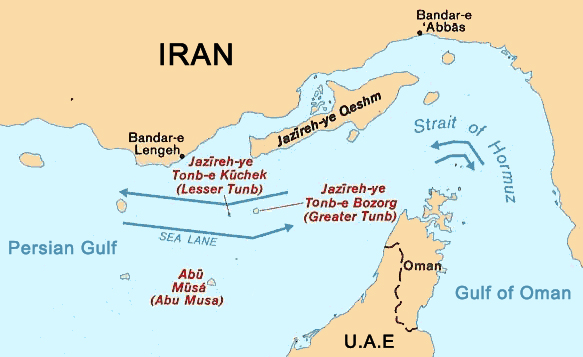
Map of the waterways near the Strait of Hormuz
This is not a new problem; others (notably former Joint Chiefs of Staff Chairman Admiral Mike Mullen) have called attention to it in the past. We do so again because of the sharply increased tensions flowing from terrorist attacks like the one on July 18 in Bulgaria in which five Israeli tourists were killed.
It is not yet known who the suicide bomber was. Yet Israeli Prime Minister Netanyahu immediately blamed Iran and Hezbollah for the attack — a claim that has not been substantiated — and threatened retaliation. Inside Iran, terrorist attacks have claimed the lives of five Iranian scientists over the past five years, with the Iranians blaming Israel.
The recent buildup of warships in the Persian Gulf has added not only to crowding, but also to a hair-trigger, volatile environment. On July 16, the U.S. Navy announced that a Navy refueling ship out of Bahrain, the Rappahannock, had used “lethal force” against a 50-foot pleasure craft, killing one Indian fisherman and seriously injuring three others.
The Navy said the fishermen had been given ample warning, but the three survivors insisted they had received no warning before being fired upon. And if that fishing boat had been an Iranian naval vessel?
As that recent shoot-up suggests, the waters of the Gulf offer the most likely locale for an incident that could spiral out of control. The navigable part of the Strait of Hormuz is narrow; it is an area where ships collide. In 2007, for example, the U.S. nuclear submarine USS Newport News collided with a Japanese oil tanker in the Strait while the submarine was transiting submerged.
Two years later, the USS Hartford nuclear submarine and the amphibious USS New Orleans collided in the waters between Iran and the Arabian Peninsula while on routine security patrols in that crowded shipping lane. In January 2008, five Iranian boats swarmed three U.S. warships in the Strait of Hormuz.
The skies over that strategic area have also seen inadvertent tragedy. On July 3, 1988, the Aegis guided-missile cruiser USS Vincennes mistakenly shot down an Iranian civilian passenger jetliner, Iran Air Flight 655 over the Strait of Hormuz, killing all 290 passengers. Iran Air Flight 655 was on a scheduled daily flight using established air lanes from Bandar Abbas, Iran, to Dubai, when the Vincennes mistakenly identified it as a fighter aircraft.
The Vincennes had sent a radio warning on the international air distress frequency, but gave incorrect altitude and position information on the plane. Thus, even if the Flight 655 crew were tuned in, they may have thought the warning was directed at some other flight. A U.S. Navy frigate, the USS Sides, reported that Iranian plane was climbing — not diving to attack — at the time of the missile strike.
Preventive Measures
At a press conference on July 2, 2008, the JCS Chairman, Admiral Mike Mullen, said that military-to-military dialogue could “add to a better understanding” between the U.S. and Iran. As far as we are aware, no such dialogue has been established.
Just before he retired, Admiral Mullen bemoaned the inevitable, and unnecessary, risk stemming from the absence of military-to-military ties: “We haven’t had a connection with Iran since 1979. We are not talking to Iran, so we don’t understand each other. If something happens … it’s virtually assured that we won’t get it right — and there will be miscalculation, which would be extremely dangerous in that part of the world.”
The following two modest proposals could go a long way toward avoiding an armed confrontation with Iran — whether accidental or provoked by any who may actually wish to precipitate hostilities involving the U.S. in the area of the Persian Gulf.
1 – Establish a direct communications link between U.S. and Iranian naval commanders in the Persian Gulf area and also between top military officials in Washington and Tehran, in order to reduce the danger of accident, miscalculation, or provocation.
2 – Launch immediate negotiations by top Iranian and American naval officers to conclude an incidents-at-sea protocol.
A communications link has historically proven its merit during times of high tension between potential enemies. The Cuban missile crisis of 1962 underscored the need for instantaneous communications at senior levels, and a “hot line” between Washington and Moscow was established the following year.
That direct link played a crucial role in preventing the spread of war in the Middle East during the Six-Day War in early June 1967.
Another useful precedent is the “Incidents-at-Sea” agreement between the U.S. and the Soviet Union, signed in Moscow in May 1972. That was another time of considerable tension between the two countries, including several inadvertent naval encounters that could well have escalated. The agreement sharply reduced the likelihood of such incidents.
We would regard with suspicion any who would oppose such common-sense measures to prevent escalation. A number of U.S. commanders in the Persian Gulf have favored such steps in the past, according to press reports. And, as indicated above, Admiral Mullen appealed explicitly for military-to-military dialogue.
The U.S. military’s feasibility analysis regarding an incidents-at-sea agreement is now with the Senate Armed Services Committee. At a bare minimum, such an agreement should be concluded as expeditiously as possible. We strongly urge you to marshal White House pressure behind getting that done.
If this promising initiative is delayed or tabled, we respectfully suggest that you consider ways to use your executive power to implement whatever steps might be possible to establish direct communication channels with appropriate Iranian authorities immediately.
For Veteran Intelligence Professionals for Sanity
Kathleen Christison, former CIA analyst
Ray Close, former CIA Chief of Station, Saudi Arabia
Phil Geraldi, former CIA operations officer
David MacMichael, former history professor, CIA analyst, and estimates officer, National Intelligence Council
Tom Maertens, former Foreign Service Officer and National Security Council Director for Non-Proliferation
Ray McGovern, former US Army infantry/intelligence officer and CIA analyst
Elizabeth Murray, former Deputy National Intelligence Officer for the Near East
Paul Pillar, former National Intelligence Officer for the Near East
Coleen Rowley, former FBI Special Agent and Minneapolis Division Counsel
Lawrence Wilkerson, Col., US Army (ret.) and former Chief of Staff, Department of State
Ann Wright, Col., US Army Reserve (ret.) and former Foreign Service Officer
Watch Streaming Broadcast Live:

LRN.fm

DLive

Telegram


1 Comments in Response to A Persian Gulf ‘Hot Line’ Proposed
I'm not sure the purpose for a US-Iran hotline Ray. In the cold war it was to help ensure immediate unfiltered/unvetted (but translated) communication (teletype, not voice, if I am not mistaken) between both nation's leaders who were responsible for deciding if that nation was going to war. Ostensibly both nations leaders did not want to go to war.
There was also parity (at least perceived) of a sorts (mutually assured destruction).
The Iranians pose zero serious threat to the nation as a whole. Iran can be a thorn in the plans of our rulers, and can even kill some of them, but the US can wipe them off of the face of the planet in under an hour if it wanted to (and was willing to absorb the consequences of its actions).
Also, clearly the rulers of the USA have been working towards 100% domination of every nation in the Middle East for at least a couple of decades. The Neocon-Petroleum-Christian-MIC chickenhawk factions have been winning the never ending cycle of war in the region. And they are closing in on the final boogeyman standing in their way: Iran. Who opposed the leaders chosen for them by the West since Mosaddegh or arguably even at the beginning of the 20th Century.
What is the point of a hotline...to send a clear ultimatum. I am pretty sure that message has already been delivered and is well understood. There shall be no peace so long as the US government rules.