



 Falcon 9
IPFS
SPACEX FALCON 9 UPPER STAGE ENGINE FULL MISSION DURATION FIRING
Written by Powell Gammill Subject: Space Travel and ExplorationNew Merlin Vacuum engine demonstrates highest efficiency for an American hydrocarbon rocket engine
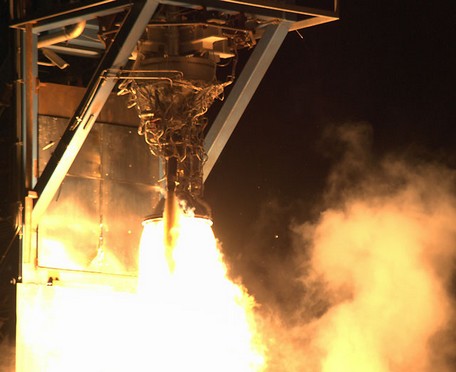
"Specific impulse, or Isp, indicates how efficiently a rocket engine converts propellant into thrust," said Tom Mueller, Vice President of Propulsion for SpaceX. "With a vacuum Isp of 342 seconds, the new Merlin Vacuum engine has exceeded our requirements, setting a new standard for American hydrocarbon engine performance in space."
Based on the Merlin 1C engine that boosted the SpaceX Falcon 1 rocket to orbit in 2008, the Merlin Vacuum engine uses a regeneratively cooled combustion chamber. However, the vacuum engine features a larger exhaust section than the Merlin 1C and a much larger radiatively cooled expansion nozzle, in order to maximize performance in the vacuum of space.
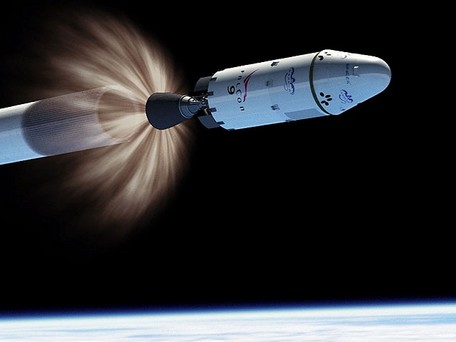
"Falcon 9 was designed from the ground up to provide our customers with breakthrough advances in reliability," said Elon Musk, CEO and CTO of SpaceX. "In successfully adapting our flight tested first stage engine for use on the second stage, this recent test further validates the architecture of Falcon 9, designed to provide customers with high reliability at a fraction of traditional costs."

About SpaceX
SpaceX is revolutionizing access to space by developing a family of launch vehicles and spacecraft intended to increase the reliability and reduce the cost of both manned and unmanned space transportation, ultimately by a factor of ten. With its Falcon line of launch vehicles, powered by internally-developed Merlin engines, SpaceX offers light, medium and heavy lift capabilities to deliver spacecraft into any altitude and inclination, from low-Earth to geosynchronous orbit to planetary missions. On September 28, 2008, Falcon 1, designed and manufactured from the ground up by SpaceX, became the first privately developed liquid fuel rocket to orbit the Earth, demonstrating that low cost and reliability can be coupled in commercial spaceflight.
As a winner of the NASA Commercial Orbital Transportation Services competition (COTS), SpaceX is in a position to help fill the gap in American spaceflight to the International Space Station (ISS) when the Space Shuttle retires in 2010. Under the existing Agreement, SpaceX will conduct three flights of its Falcon 9 launch vehicle and Dragon spacecraft for NASA, culminating in Dragon berthing with the ISS. SpaceX is the only COTS contender with the capability to return cargo and crew to Earth. NASA also has an option to demonstrate crew services to the ISS using the Falcon 9 / Dragon system.
NASA recently selected the SpaceX Falcon 9 launch vehicle and Dragon spacecraft for the International Space Station Cargo Resupply Services (CRS) contract award. The contract includes 12 flights between 2010 and 2015, which represents a guaranteed minimum of 20,000 kg to be carried to the International Space Station.
Founded in 2002, the SpaceX team now numbers more than 620 full time employees, located primarily in Hawthorne, California, with additional locations, including SpaceX's Texas Test Facility in McGregor near Waco; offices in Washington DC; and launch facilities at Cape Canaveral, Florida, and the Marshall Islands in the Central Pacific.


