The American Revolution began long before the Declaration of Independence was
adopted on July 4, 1776 or even before the warʼs first shots were fired at Lexington and
Concord a year earlier on April 19, 1775. Years after the war, John Adams would reflect
that “the Revolution was effected before the war commenced. The Revolution was in the minds and hearts of the people. This radical change in the principles, opinions, sentiments and affections of the people was the real American Revolution.”
While friction caused by the British mercantilist system served as the physical spark for
the Revolution, the rejection of the monarchal political system was its intellectual fodder.
Thomas Paine, for instance, wrote in Common Sense, “of more worth is one honest
man to society, and in the sight of God, than all the crowned ruffians that ever lived.”
Thus, Thomas Jeffersonʼs declaration of universal individual rights was an idea whose
time had come: “We hold these truths to be self-evident, that all men are created
equal, that they are endowed by their Creator with certain unalienable Rights, that
among these are Life, Liberty and the pursuit of Happiness.” No longer would one man
or group of men be superior in the eyes of the law.
But was all this really revolutionary? Certainly, putting these ideas into practice and
breaking the political bonds with Great Britain were revolutionary acts in that they
represented a departure from the past, but the ideas didnʼt start with the Founding
Fathers. Jeffersonʼs enunciation of nature rights, for example, was simply a rewording
of John Lockeʼs theories.
After much soul searching, the colonies finally seceded from Great Britain because they
felt that the King was violating the British constitution, the traditional rules that governed
the Kingʼs relationship with his subjects. In other words, the Revolution began as a
reaction to a violation of conservative, i.e. traditional, norms. The colonists were forced
to consider radical ideas because the existing order denied them redress of their
grievances.
The Founding Fathers, however, were still men of their time and operated under their
own particular philosophical premises. Their fatal premise was that coercive
government was a “necessary evil.” The best of the Founders, broadly speaking
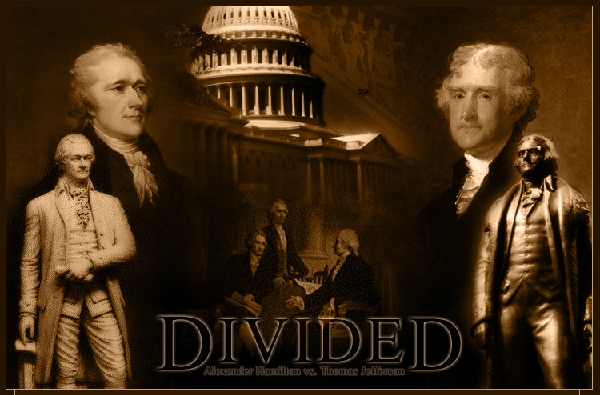
Jefferson and the anti-federalists, sought a government limited to the protection of life,
liberty, and property. The worst of the Founders, Alexander Hamilton and his ilk, didnʼt
have a problem with the British system per se. They just had a problem with the fact
that it was administered by the British and not them. The Hamiltonians sought a
powerful State which they would eventually control. Their limited government rhetoric
was simply that--rhetoric designed to camouflage their real goal. Just compare what
Hamilton wrote in the Federalist Papers addressing concerns that the central
government which the Constitution created would be a threat to individual liberty, with
what he wrote after the Constitution was ratified. Once the Constitution was adopted,
Hamilton immediately went about enlarging the scope and power of the federal
government. This was exactly what the anti-federalists feared.
Many libertarian revisionist historians now recognize that the U.S. Constitution was not
the final chapter of the glorious American Revolution as civics textbooks portray. The
1787 convention in Philadelphia was a coup dʼetat which subverted the libertarian
aspects of the Revolution and created what would become the biggest, most powerful
government the world has ever seen.
Thus, what began as a revolution ended as merely an exchange of masters. Americans
swapped the royal “we” for the democratic “we”. Unfortunately, one of our most difficult
tasks is convincing folks that “we” are not the government. While we can influence the
State to some extent, the government is a specific set of individuals and institutions
which are distinct from society itself. Pointing that out often evokes resistance and
sometimes outright hostility.
Nevertheless, it is imperative that we question the premises upon which contemporary
political philosophy is based. At the very least, we can inject a different point of view
into political discourse. Right now, this may seem futile. However, we never know what
the future holds and what opportunities it may present. Human history is not the linear
progression that we have been taught. It can best be described as a series of radical
upheavals during which almost everything suddenly changes followed by longer periods
of relative stability (often coming at the expense of liberty) in which things change very
slowly. We are currently on the precipice of one of those radical upheavals.
Just like the colonists in 18th century British America, todayʼs Americans are finding that
the current system is a fraud. As the economy continues to unravel, many more will
come to this conclusion. The question is, what will replace our system. Will it be one
that enhances individual liberty or one that crushes it?
There is much to learn from the Founding Fathers, but unlike Conservatives who treat
the Founders as the American pantheon, the most important part of the lesson can be
derived from their failures. Many of the Founders were courageous and placed their
liberty ahead of their lives and fortunes. We can certainly admire these qualities.
Unfortunately, slavery and the treatment of native Americans were inexcusable and will
always be a tragic blight on their legacy.
In addition to these defects, as an anarcho-capitalist, I find the Founderʼs other major
shortcoming in that they did not reject the State altogether. There is no such thing as
limited coercive government. Inevitably, the State will expand and liberty will contract.
History has now proved that no piece of paper can stop this process for long.
Even so, the American Revolution was an important, if imperfect, step in our political
evolution. While reading Ludwig von Misesʼs Human Action recently, I was struck by the
contrast between the classical liberal Mises and his student Murray Rothbard, the
anarcho-capitalist. Like the American Founders, Mises arrived at the conclusion that a
limited government holding a monopoly on the initiation of force was a necessary evil.
Building on Misesʼs work, Rothbard came to the opposite conclusion: the State is not
necessary; it is simply evil. Despite this irony, without Mises there probably never would
have been a Rothbard. Misesʼs classical liberalism served as a bridge that ushered in
Rothbardʼs anarcho-capitalism.
The same can be said about the American Revolution. We are now engaged in the
process that Adams identified. By injecting the ideas of individual liberty, free markets,
and peace into the political discourse, we hope to bring about “radical change in the
principles, opinions, sentiments and affections of the people.” We are continuing the
American Revolution, building upon the work that the classical liberals of that era left us.
But itʼs not a violent revolution that we hope for. And itʼs not confined to America.
Itʼs nothing less than a peaceful worldwide evolution.