Why is the US involved in endless war around the world? Why, for that matter, do nations â€" or, rather, their governments â€" act the way they do? The number of answers is no doubt nearly equal to the number of questioners. It’s all about economics, say the Marxists (and the Hamiltonians): imperialism is the highest stage of capitalism. No, say the “realists,” it’s all about the objective “interests” of various nations, and the interplay of those “interests” in the international arena. The neocons have a different explanation: it’s all a matter of “will” and “national purpose,” or a lack of same: imbued with a sense of our “national greatness,” America will spread democracy all over the world â€" or else go into a shameful decline in which spiritual loss precedes the loss of the war-making spirit.
Yet none of these supposedly overarching theories provides an adequate explanation for how and why we find ourselves in our present predicament. America has bankrupted itself building a global empire with bases, protectorates, and colonies on every continent â€" and yet still we persist in pursuing a policy that is taking us to the brink of the financial abyss. Our social safety net is in serious disrepair, and shows every sign of failing: our banking system is a rickety house of cards, and the national housing crisis â€" the latest manifestation of the financial bubble â€" is dragging the middle class down into penury. Yet still we send billions â€" nay, trillions â€" overseas to prop up a precarious overseas empire. How is this possible â€"and why is it happening?
In positing a libertarian theory of international relations we depart from the prescriptive and focus on the descriptive: that is, we ignore â€" for the moment â€" the question of what the ideal foreign policy ought to be, and concentrate on the problem of describing how our present policies are formulated and implemented. We start, therefore, with the question of who is doing the formulating.
In “democratic” societies, we are
told, “the people” are the ultimate policymakers, because they â€" in theory â€" hold their rulers accountable, not only at the polls but in the forum of public opinion and whatever parliamentary apparatus shares power with the executive. In practice, however, foreign policy is a completely
separate realm, the domain of “
experts” and
specialists ensconced in think tanks â€" and, of course, the higher reaches of
the councils of state.
Furthermore, unless a major war is in progress, one that has an obvious effect on the economic and political life of the nation, foreign policy is the least of the public’s concerns. This is especially true in the US, but also in a broader sense: it’s only natural that people are usually concerned with events closer to home, where their knowledge of the context is more extensive.
This distancing of the citizenry from the policymaking process is accentuated, in the US, by the erosion of congressional power in the foreign policy realm. In the latter days of the American empire, policy is made almost entirely within the White House and the national security bureaucracy: Congress ceded its war-making powers long ago.
The conduct of America’s â€" or any country’s â€" foreign policy, therefore, is the province of a very small group at the very top of the political pyramid: what might be called, for lack of a better group description, the ruling class, otherwise known as the “Establishment.” These are the chief actors, â€" aside from freelancers like terrorist groups, various “liberation” movements, and George Soros â€" on the world stage.
To answer the question posed at the beginning of this article, it is necessary to ask what motivates the Establishment: what causes them to come to a consensus and act? For libertarians, and for those of a realistic mindset â€" not always the same thing â€" the answer is simple: it’s all about power.
The retention and expansion of political power is the central task of every ruling class throughout history, no matter what their ostensible ideological orientation. Dictatorships, democracies, and everything in between all share this common trait: it is the organizing principle at the core of the policymaking machine, the brain behind the brawn. The various ideological explanations offered by these elites for their actions are invariably self-serving and ultimately irrelevant rationalizations: for example, the old Communist elites pretended to be working toward the establishment of the communist system worldwide, but in fact were devoted to the creation of “socialism in one country,” i.e. feathering their own nest. In the West, political leaders insist their goal is the spread of liberal democracy and its alleged economic benefits, but the reality is that they’re more concerned with their campaign treasuries and their poll numbers: the old mottoes of the Anglo-Saxon ruling class, which upheld the principle of “noblesse oblige,” are so timeworn and tattered that no one even bothers to invoke them any longer.
The politicians, in short, are in it to stay in it: they are in the business of acquiring and keeping power, and that is what motivates them in all matters foreign and domestic. The “national interest,” the “world revolution,” the peculiar destiny afforded us as sainted beneficiaries of “American exceptionalism” â€" all these disparate brands of ideological snake-oil, boiled down to their essence, are just naked self-interest colored with various shades of rhetorical mumbo-jumbo.
A wise ruler â€" say, Marcus Aurelius â€" may realize the prolongation of his rule (not to mention the judgment of history) depends on pursuing peaceful, relatively beneficent policies, whereas a foolish and/or evil one â€" say, Hitler â€" may pursue policies that seem to expand his power in the short term but doom him in the long run, Yet both are similarly motivated by an overriding ambition â€" to wear the Ring of Power, and thus shape the course of events.
In seeking to understand why governments as international actors take or refrain from taking a certain course, the first task of the intelligent observer is to look toward the home front. The “official” explanations for such actions are invariably tied to some “crisis” that exists thousands of miles away, usually attributed to dastardly deeds of the villain-of-the-month. In reality, the true cause is usually much closer to home â€" and staring us in the face.
For example, let’s look at the events in Libya, where we were told that, unless the US and the NATO alliance intervened, as many as a hundred thousand civilians would be slaughtered by forces loyal to Moammar Gadhafi. This alleged “humanitarian crisis,” however, turned out to be the same old war propaganda, on a par with the Kuwaiti incubator babies â€" but not quite as convincing as those Belgian babies supposedly speared on the Kaiser’s bayonets.
We’re doing it for “the children” â€" now that’s the kind of war Secretary of State Hillary Clinton can get behind! And she certainly did: indeed, it was her, in league with two other prominent “progressive” harpies in the national security high command, who demanded US action, which the President was clearly reluctant to take. Yet he went along with it in order to appease the increasingly restless Clintonian wing of his party â€" which has been aggressively pushing Hillary as a replacement for Biden on the 2012 ticket â€" and to placate George Soros. The sudden declaration of a “humanitarian crisis” was a laughably transparent pretext for intervention â€" a reality even clearer in retrospect, as the real humanitarian crisis precipitated by various rebel “militias” unfolds in such loyalist strongholds as Sirte and western Libya in general.
The real reason for the Libyan adventure was the necessity of averting a political crisis inside the Democratic coalition: Obama wanted a “team of rivals,” and that is what he got. Having ceded the foreign policy of his administration to the Clintons, the President had little choice but to let Hillary assert herself: Libya was her war, and Obama let her have it for purely internal political reasons.
Our embarrassingly vacillating policy on the question of Palestinian statehood, and the Israeli-Palestinian conflict in general, is another prime example of how internal political dynamics drive foreign policy decision-making. After a promising start, the Obama administration
abandoned its much-reviled-by-the-neocons policy of “even-handedness,” and wound up capitulating to the Israeli rejectionists and their “settlement” policy, even joining them in
disdaining the Palestinian Authority’s bid for UN recognition of a goal long sought by US Presidents, including Bill Clinton and
George W. Bush: the creation of a Palestinian state. Why the sudden turnabout?
As onetime Democratic presidential candidate Wesley Clark pointed out, big donors to the party â€" “
the New York money people” â€" don’t look kindly on candidates who fail to toe the Israeli government line. The timing of the grandstanding UN veto is also a clue: barely a week after the
defeat of a Democrat in a heavily Jewish New York congressional district previously colored the deepest blue. The latest wrinkle in fast-deteriorating US-Iranian relations â€" the
phony Iranian “terrorist” plot supposedly engineered by an alcoholic used car salesman â€" is yet more living evidence that foreign policy has less to do with realities on the ground than it does with the internal political requirements of the various actors. At a time when the President’s reelection prospects are looking increasingly grim, the Obama administration
is afraid of losing key donors and voting blocs who doubt his commitment to Israel’s “security” â€" and,
voila!, the Great Turnabout is in progress.

In positing that it’s the internal politics of a country that are key to understanding its relations with other states, it’s important to make no distinctions, either ideological or structural, between them. That is, one must strip away the self-descriptions and other conceits that mask the underlying commonality of all states everywhere. Whether we are talking about democracies, or monarchies, “people’s republics” on the old Soviet model or banana republics a la Hugo Chavez, the same rule applies: the “Establishment,” whether it be capitalist, “socialist,” theocratic, or some other flavor of ideological Kool-Aid, is bound and determined to hold on to power, and will go to practically any lengths to acquire more.
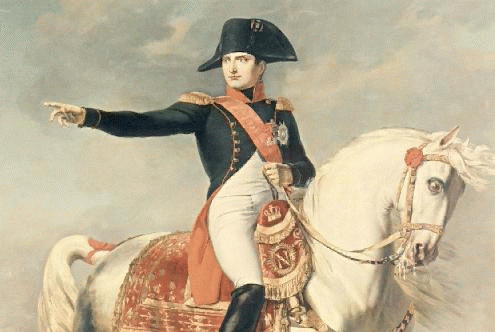
This commonality is demonstrated by the fact that democracies are just as likely to engage in imperialistic wars as are dictatorships of one sort or another: our current policy of endless war demonstrates this rule rather dramatically, and history confirms it. Britain, by far the most liberal and democratic empire that ever existed, was simultaneously the greatest aggressor, relentlessly expanding the Empire to nearly every continent, abolishing slavery â€" and enslaving millions. The French revolutionaries were similarly expansionist, as dramatized by the career of a certain French corporal. Like Rome, the Athens of classical antiquity â€" founder of the democratic ideal â€" started out a republic and later acquired an overseas empire which eventually led to their downfall.
A libertarian theory of foreign affairs starts with the axiom that those in power wish to remain in power: all else follows from this basic proposition. It’s the “all else,” however, that is the important part, and not a mere detail to be filled in later. Because political and policy decisions are made by real people, not impersonal “forces” and floating abstractions, the specific context in which these decisions are made is key to understanding the course of events. It is not enough to say that there is some Vast Conspiracy â€" say, the Illuminati, the Bilderbergers, or the Elders of Fandom â€" operating behind the scenes and manipulating the “crisis” of the moment to its own advantage. It is necessary to cite specifics, i.e. evidence establishing causal connections between specific individuals, certain policy outcomes, and benefits accrued.
This is why journalism is such an important branch of the literary arts, and why its decline is such a blow to the cause of peace and liberty. Without specifics, and unarmed with facts, neither the professional analyst nor the interested citizen can get a clue as to what is going on with the biggest â€" and most dangerous â€" power on the planet. That’s why Antiwar.com is such an important tool in the fight against interventionism and militarism: because we give you the news they don’t want you to know about. Our ear is always to the ground, listening for the telltale signs of yet another “war for democracy” and/or “humanitarian crisis” requiring US military intervention. Taking you behind the headlines, we give our readers the real lowdown on the War Party’s latest moves â€" and, like the War Party, we never rest.
We cannot rest, because the tendency of governments to constantly seek opportunities to expand their power â€" including across national borders â€" is inherent and constant. It can be neither eradicated, nor ignored: it has to be constantly watched â€" and challenged. That’s why we’re here, and that’s why we must continue to be here for as long as governments exist.