Just so we have a very basic understanding of how the internet works, I want to clarify a few things for you. The internet is NOT the World Wide Web. The web is just one of many protocols that run on the TCP/IP stack. There are over 65,000 ports that can be used for the transmission of data, your computer only uses 1 to initiate a web page request. You can run multiple connections to the same port. Different protocols run on different ports. I'm going to be describing some of these protocols and the applications that are used to interact with them. These tools listed below are OUTSIDE of the web.
Way back in the day, before the World Wide Web, the internet still existed... many people just wouldn't recognize it. Before web browsers, people communicated through terminal applications and accessed such internet services as IRC (Internet Relay Chat), Gopher (a sort of data warehousing system), FTP (File Transfer Protocol), Usenet which used the NNTP (Network News Transfer Protocol) and even email. Since the rise of the web browser, we've seen the popularization of Peer To Peer (P2P networks), cloud storage and anonymous file hosting services.
IRC was one of the first protocols to gain massive popularity as a place to obtain pirated works. IRC servers are easy to access if you have the proper software and a little bit of know-how. IRC servers host channels (pretty much the same thing as a chat room) where people can join and talk about whatever they want. For instance #cisco on EFNet is where network engineers used to go and talk about Cisco routers, but now it's full of gloating
ass-hats that will ban your entire IP block for asking a question. Channels are not necessarily open to anyone, and you can create whatever channel you wish. If you have ever visited the
Free Talk Live webcam/chatroom, you've seen #LRN on MIXXnet as that is what they are using behind their chat module.

Once a channel is abandoned (the last person leaves a channel), it can be reborn and taken over by anyone; so people wrote scripts to make sure that their channels were never abandoned. If the wrong person ever received administrative powers to the channel (known as ops), the channel could be taken over and held hostage. Nerd drama. Someone needed to come up with a way of keeping the ops privileges for their own channels and bots hit the scene.
The invention of bots was a significant milestone. Bots are scripts that pretend to be people on IRC. While they started off as simple placeholders, they quickly developed into autonomous overlords of the IRC underground. You are able to issue commands to a bot that you control by direct messaging it instructions. Bots can also be set to automatically provide its owner, or a group of friends, with voice or ops privileges.
IRC is famous for being full of egotistical and power hungry people that will relentlessly attack you, or ban you... and the same goes for their bots. Say the wrong thing and be banned from a channel forever. I'm not getting into a private property argument here, just take it as a warning if you will.
Whenever there is a group of people, it is likely that they want to communicate and share ideas. That is one of the driving forces behind so called "piracy." If I just heard a great song and I want to share it with a friend, then I'm going to find a way. If the man says I can't, that just means I get to try harder, and that's what gave rise to the IRC CCTP file sharing protocol.
After joining a specific channel on IRC, you can communicate directly with bots. They will send you a list of files they are serving and you can request packages of software. Often times, these bots are running on home computers so the transfer speed is slow due to the uplink bottleneck on the server side... however, there are some incredibly fast CCTP servers that can feed as much information as you can take. The slower servers would tend to put you in a queue were you would have to wait for the people in front of you to finish their transmission. If you were patiently waiting your turn to download a requested package and there was another IRC user that had access to a botnet, they could flood your connection with ridiculous amounts of identity (and other types) of requests that would get you dropped from the server and lose your place in line. Oh, the joys of IRC.
Predating IRC by nearly two decades is the age old Usenet system. Usenet was originally developed to share text based messages between systems that could not keep a constant connection running. Over time, the protocols ran on Usenet developed the ability to encode binary information. This simply means that you can post more than text... files like pictures, software and music could now be shared.
Even though the Usenet platform was capable of handling binary information, the technology to take advantage of the feature was not common. It would take the leap to a broadband world to make Usenet reach its potential for sharing files. In the 1990s, most ISPs provided Usenet access to their subscribers. It wasn't until the early 2000s that ISPs saw the bandwidth being consumed over Usenet and started to either severely cripple their Usenet offerings or completely remove it all together.
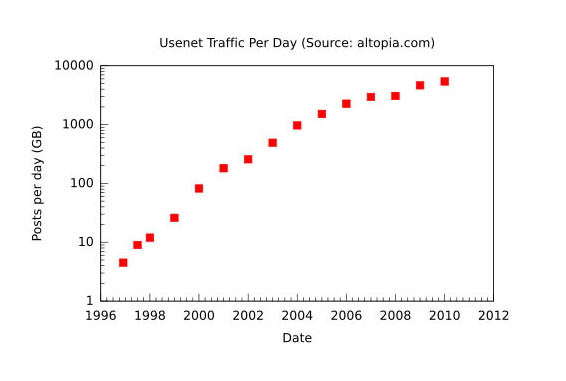
Usenet servers are typically designed in a way so that every Usenet server has ever Usenet posting. This consumes a massive amount of data and a huge pipeline must be dedicated to moving so much data.
For instance, in 1996, the average daily volume on Usenet was 4.5 GB. By the year 2000, Usenet servers were seeing daily volume in excess of 80 GB. For January of 2012, Usenet daily volume was 9.29 TB per day. That's TERABYTES, with a "T." That is a LOT of data.
As ISPs dropped their support of Usenet, a new business model emerged to fill the market need. Premium Usenet service providers are now available and can provide as much information as your downstream connection can handle. As people began to worry about their ISP tracking what they were doing, the premium Usenet service providers began offering encrypted connections for another premium price.
SSL encrypted connections use advanced algorithms to shield the actual content of what is being passed through the internet to your computer. Of course, the ISP can still see that you are connected to a Usenet server, but they can't tell what you are downloading. With the competition in the Usenet provider field, SSL encrypted connections are now available with unlimited bandwidth for less than $15 per month.
Here is a nice primer on how to get started with Usenet.
Usenet is still very active (see the daily transfer numbers above) and has lead to a lot of great, innovative software development. In order to connect to a premium Usenet provider, you have to have a Usenet client. In the past, these would cost you around $20 (which was easy to get around), but now, the open source community has created
SABNzbd+ (commonly just called "SAB"). SAB runs on Linux, and windows and there is a forked version named Hella for Mac OSX. SAB is the mission control station for your Usenet downloads as it communicates directly with the Usenet server. It also has an open and robust API which means people can write add-ons or scripts that increase its abilities. And since it is open source, it leaves room for a lot more innovation.
One of these innovations is called
SickBeard (which also works with torrents). SickBeard is like a Tivo/PVR for the internet. You can subscribe to TV shows and as they become available, they are automatically downloaded by SAB. The only limit to how many shows you keep is your hard drive space. You can tell SickBeard to grab standard definition or HD content and it is highly customizable and you never have to worry about DRM ruining your viewing experience. SickBeard has been on the scene for several years and is still being actively developed.
Another great add-on to the SAB project is a new up and coming application named Headphones. Headphones is like SickBeard, but for music. You can add an artist to your watch list and any time they have a new album come out, Headphones will just grab it and send it to SAB. Headphones is a relatively new software package and it is still being actively developed and improved.
And to finish out this group of incredible Usenet applications we have
Couch Potato. Couch Potato watches for movies and automatically downloads them when they are available. If there is an amazing movie that you want to see ASAP (and don't mind a low quality version), you can tell CP to just download a CAM (low quality video camera recording from inside a movie theater)... but you can also let CP know that you want to replace that version with a DVD Rip when it is available. Couch Potato has been around for a few years as well and is still being actively developed... just at a slower pace.
A major milestone was reached in 1999 when Napster came on the scene. Napster was the first of many Peer to Peer (P2P) networks that made sharing files a team sport. If you had music on your hard drive, you could share it with the world. One of the major down sides to Napster's model was the fact that it relied on a centralized server to do indexing. You could not find data without connecting to a Napster server.
This centralized system would be the downfall of the original Napster. The "intellectual property" rights holders of the music being "infringed" were able to go after a single entity. By July of 2001, the RIAA was successful in taking Napster offline, but the flood gates had been opened. Napster was the first, but it would not be the last. Grokster, Kazaa, eDonkey2000, Gnutella and other sharing software would come and go, but a new technology was coming... one without a central server to be taken offline.
Enter Bit Torrent.
Bit Torrent was first introduced in July of 2001 and within a year was one of the new standards for internet piracy. While the technology was not specifically designed for sharing copyrighted material, it was soon synonymous with the act. By 2002, The Pirate Bay was online which is a single website that tracks torrents and makes it easy to find whatever you want.
So, what exactly is a torrent? A torrent is kind of like a road map to help you find something. The torrent is just a step by step list of places to look for a certain file. It would point you towards many different "trackers" that would then help you link up with people all over the world to download a single file from multiple people. This "many to one" approach is what made bit torrent so popular. With previous iterations of P2P systems, like Napster, you were often stuck downloading a single song from a single sharer. If the sharer had a slow uplink speed, your download speed would be slow. With bit torrent, you can pull the same file from many sharers at the same time and increase your download speed.
The RIAA and MPAA, as well as their European counterparts, went after The Pirate Bay. They were able to take it offline briefly, but it just came back stronger and better than before.... but there was still a centralization issue left to address with the bit torrent protocol. In order to get the torrent roadmap to the files you were seeking, you had to somehow obtain the map. Torrent trackers were also a weakness that had to be dealt with.
The next solution was for
magnet links. Magnet links are not all that new having hit the scene in 2002, but they will be used for the foreseeable future in connecting to P2P networks. Instead of having to download the torrent road map, you simply need a hashed security string and your bit torrent client will take care of the rest. On
February 28th, 2012, The Pirate Bay switched to only supporting Magnet links.
Now, The Pirate Bay does not need to host torrent files and can just provide a hashed equivalent. " Since it refers to a file based on content or
metadata, rather than by location, a magnet link can be considered a kind of
Uniform Resource Name, rather than the more common
Uniform Resource Locators. Although it could be used for other applications, it is particularly useful in a peer-to-peer context, because it allows resources to be referenced without the need for a continuously available host."
Since The Pirate Bay has switched to using magnet links, their entire site has greatly reduced in size. You can now download an exact copy of the entire website... and it is only 90 MB. That's right, a roadmap to the largest collection of culture ever assembled fits on a
zip drive that came out in 1994.
Bit torrent is not 100% safe to use. People have been sued for downloading TV shows, movies, and music through P2P networks. One of the downsides of bit torrent is that when you are downloading from multiple people at a time, one of those people could be the MPAA or RIAA... and they are tracking what IP addresses connect to their system. There are ways around this by using a
torrent proxy, but they typically slow down your transmission speeds. There are also programs you can run on your computer that maintain a black list of IP address known to be tracking its users. These "intellectual property" traps could loosely be referred to as "
honey pots."