|
Noisebridge and the Hackerspace Community
By:
Mitch Altman
Noisebridge is part of the Hackerspace community, which are community-operated physical places where people can meet and work on their projects. Hackerspaces can be viewed as open community labs incorporating elements of machine shops, workshops and/or studios where hackers can come together to share resources and knowledge to build and make things.  What is Noisebridge? What is Noisebridge? Noisebridge provides infrastructure and collaboration opportunities for people interested in programming, hardware hacking, physics, chemistry, mathematics, photography, security, robotics, all kinds of art, and, of course, technology. Through talks, workshops, and projects we encourage knowledge exchange, learning, and mentoring. Noisebridge's hours are 24 hours a day, 7 days a week. New visitors are welcome any time (all ages, all skill levels), but it's best to visit in the evenings or during an event to make sure we have a volunteer to show you around and make introductions. We're located at: Our Name A "noise bridge" is a piece of electronic test equipment that injects noise into a system to see how it responds, so you can fix or improve it. Such a device is often used in RF electronics.
As a space for artistic collaboration and experimentation, we are open to all types of art - with a special emphasis on the crossover of art and technology. From hardware labs to electronics, cooking, photography, and sound labs, anything that's creative is welcome. Here are some of the collaborative efforts at Noisebridge: Programming • Hardware • Physics • Chemistry • Mathematics • Photography • Security • Robotics • Art • Technology
Many interesting things are happening at all times. Sharing is essential to making this work. We believe in starting from a point of respect and trust. We believe it builds a safe community and that this will foster innovation and creation. Our code of conduct is "Be excellent to each other". Leadership is taken by individual members for specific projects. We call this "sudo leadership" after the *nix command sudo which allows a regular user to do one root-level, or superuser, task. In other words, if you want Noisebridge to do something, start doing it. Here's some paraphrasing from our bylaws: Through talks, classes, workshops, collaborative projects, and other activities, we want to encourage research, knowledge exchange, learning, and mentoring in a safe, clean space. We provide educational spaces for teaching practical skills and theory of technology, science, and art. We provide work space, storage, and other resources for projects related to art, science, and technology that will benefit the individual members' personal growth in their fields of interest, encouraging the individual members to share their projects and knowledge for the betterment of society through art, science and technology. We create, learn, and teach, individually and as a group, inviting members of the community in the San Francisco Bay area and the world. We develop, support the development of, and provide resources for the development of free and open source software and hardware for the benefit of society. We promote collaboration across disciplines for the benefit of cultural, charitable, and scientific causes.
Excellence Be excellent to each other is the guiding principle of Noisebridge. Wikipedia uses a somewhat similar rule, which they call "the fundamental rule of all social spaces. Every other policy for getting along is a special case of it." Unlike Wikipedia, Noisebridge takes a positive approach, and avoids the practice of officially enumerating the myriad potential special cases; "be excellent" is enough. Consensus We make official Noisebridge decisions by consensus, which means the willing consent of all of our members. Decisions are made at our weekly meetings, and items proposed for consensus are announced at least a week in advance to give everyone time to hear about them. Members may block by proxy if they are unable to attend or if they wish to block anonymously. More information on the Consensus Process. Do-ocracy Doing excellent stuff at Noisebridge does not require permission or an official consensus decision. If you're uncertain about the excellence of something you want to do, you should ask someone else what they think. Financing it We self-finance through membership fees ($80 per member/month with $40 "starving hacker" rate), beverage sales, and parties, the way European hacker spaces do it. We also welcome one-time or recurring donations from members and non-members alike. Donations and sponsorships will accompany renovation and equipment purchase. Within the first 24 hours of renting a space, we raised over $10,000 for a cool location and meaningful projects. Within our first month, we've nearly become cash flow positive from membership dues alone. Further discussion is happening on the Finances wiki page. Inspiration Noisebridge is inspired by similar European clubs like Metalab of Vienna, CBase of Berlin, MAMA of Zagreb, and ASCII of Amsterdam. Many other clubs of a similar stripe can be found at Hacklabs and Hackerspaces dot Org. It would not be out of the question to consider Noisebridge a possible San Francisco Chaostreff. Noisebridge is a hacker space and community that shares a Dorkbot-like ethic, and indeed, many of the members of Noisebridge are long-time Dorkbotters. Click Here for Current Events and Calendar
Open Source Creativity - Hackerspaces: Science on the SPOT:
You can do just about anything with electronics if you know how to solder, so this is a very important skill to have, and it's easy.
Soldering is Easy - Here's How to do it (PDF)


___________________________________
Events, workshops, classes! Every week there are lots of activities at Noisebridge, planned and otherwise. Check the wiki for upcoming events, workshops, and classes. And feel free to add your own!
Noisebridge is a fairly open and permissive space, and the equipment (unless otherwise marked, or on a member shelf) is open for public use. Safety first! Feel free to come to Noisebridge to work and play on your project, or help others with theirs.
Noisebridge has lots of space available as a community resource for individuals and organizations to use -- please use it!
Can I leave my stuff here? Noisebridge is open to the public, so use your judgment when leaving valuables here. Noisebridge is not responsible for lost or stolen items. Avoid leaving your bicycle here overnight. The daily storage shelves provide a space to leave your things for the day. The lost and found box is located on top of the shelves. Members can leave items on their labeled member shelf for an extended period. Please label any projects left here with your name, email, and the date. Putting your project into a box labeled with your name is best.
Tour of Noisebridge:
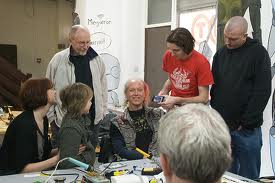 Mitch Altman is a San Francisco-based hacker and inventor, best known for inventing TV-B-Gone remote controls, a keychain that turns off TVs in public places, he was also co-founder of 3ware (a SillyValley RAID controller company), did pioneering work in Virtual Reality at VPL Research, invented the NeuroDreamer sleep mask, and created the Brain Machine, one of MAKE Magazine's most popular DIY projects. He has contributed to MAKE Magazine, has written for 2600, and for the last several years has been leading workshops around the world, teaching people to make cool things with microcontrollers and teaching everyone to solder (as he does at Noisebridge every Monday night when he's in town). He is also co-founder of Noisebridge, and President and CEO of Cornfield Electronics. He is about to launch his latest project: NeuroDreamer sleep mask, to help people rest, and help people lucid dream.Visit his webpages at CornfieldElectronics.Com and Noisebridge.Net. Mitch Altman is a San Francisco-based hacker and inventor, best known for inventing TV-B-Gone remote controls, a keychain that turns off TVs in public places, he was also co-founder of 3ware (a SillyValley RAID controller company), did pioneering work in Virtual Reality at VPL Research, invented the NeuroDreamer sleep mask, and created the Brain Machine, one of MAKE Magazine's most popular DIY projects. He has contributed to MAKE Magazine, has written for 2600, and for the last several years has been leading workshops around the world, teaching people to make cool things with microcontrollers and teaching everyone to solder (as he does at Noisebridge every Monday night when he's in town). He is also co-founder of Noisebridge, and President and CEO of Cornfield Electronics. He is about to launch his latest project: NeuroDreamer sleep mask, to help people rest, and help people lucid dream.Visit his webpages at CornfieldElectronics.Com and Noisebridge.Net.
|


