Knowing the Battlefield
 Many anarchists and libertarians will eagerly study the psychology of tyrants, dubbed “Authoritarian Sociopathy,” in an effort to know their enemy in the battlefield of politics. Getting into the minds of our enemy is regarded as a strategy, a means to a political end… and an end to politics. However, I would suggest that the mind of our enemy is the battlefield itself, and politics is merely one of many strategies. We cannot fight the State with votes, or with cameras, or even with rifles, because factually the State only exists in the mind.
The common definition for the State is a “monopoly on violence.” This was originally coined by German political philosopher Max Weber in 1919, affirmed by Austrian economist Murray Rothbard in his book Anatomy of the State, and even recently echoed by authoritarian sociopath Barack Obama. This definition is seldom disputed, even by the agents of the State. However, as surely as a pickpocket can knife you in the ribs, the State does not factually enjoy a monopoly on violence. The missing component is an often overlooked, but all important adjective: legitimate. The State is a monopoly on legitimate violence, and legitimacy is the only thing distinguishing a tax collector from a pickpocket, a police officer from a vigilante, or a soldier from a paid murderer. Legitimacy is an illusion in the mind without which the State does not even exist.
This illusion not only exists in the minds of the authoritarians. It exists in the minds of every subject they oppress. And every place that this illusion finds safe harbor is a trench in the field of battle.
Power and Obedience
For those interested in the science behind authoritarian sociopathy no studies are more poignant, or more chilling in their ramification than the Milgram Experiment and the Stanford Prison Experiment. But their sentiment was perhaps best expressed by Thomas Jefferson in an often overlooked passage of the Declaration of Independence:
“All experience hath shewn, that mankind are more disposed to suffer, while evils are sufferable, than to right themselves by abolishing the forms to which they are accustomed.”
After World War II the world stood in shock and horror as the details of the Holocaust came to light. Jew, Gypsies, Homosexuals and virtually anyone deemed an enemy of the state were put to death by the Nazis. The constant, even robotic refrain from these soldiers during the Nuremberg Trials was “I was just following orders.” As the world cried, “Never again!” Stanley Milgram, a Yale University psychologist asked, “how did this happen in the first place?” The Milgram Experiment was designed to measure the willingness of otherwise psychologically healthy people to obey the unethical orders of an authority figure. His shocking results were published in the 1974 book, Obedience to Authority: An Experimental View.
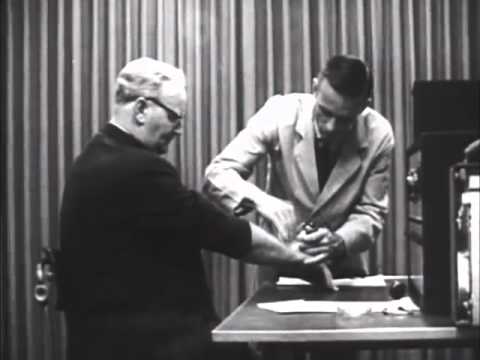
In the Milgram Experiment participants were divided into “teachers” and “learners” and placed in separate rooms. They could communicate, but could not see each other. The experimenter instructed the “teachers” to read questions to the “learners” and if they answered incorrectly to administer an elecro-shock of ever increasing voltage. The “teachers” were unaware that the “learners” were actually plants and the electro-shocks were fake. The “teachers” were the actual subjects in the experiment. After a few volt increases the “learner” began to object, to bang on the walls and complain about a heart condition. After some time the “learner” would go silent. If the subject asked to stop the experiment for any reason he was given a succession of verbal prods by the experimenter to continue. "Please continue," "the experiment requires that you continue" "you must continue," etc. Most continued after being told that they would not be held responsible.
Psychologists predicted only 1% of subjects would administer a lethal shock, but were utterly shocked when 65% administered the experiment's maximum massive 450-volt shock even though every subject expressed some level of objection in doing so. Some began to laugh nervously. Others offered to refund the money they were paid for participating in the experiment. Some exhibited signs of extreme stress once they heard the screams of pain coming from the learner. But the vast majority were willing to administer a lethal jolt of electricity to a complete stranger based upon nothing but the verbal prodding of a scientist in a lab coat. None of those who refused to administer the deadly shock insisted that the experiment itself be terminated.
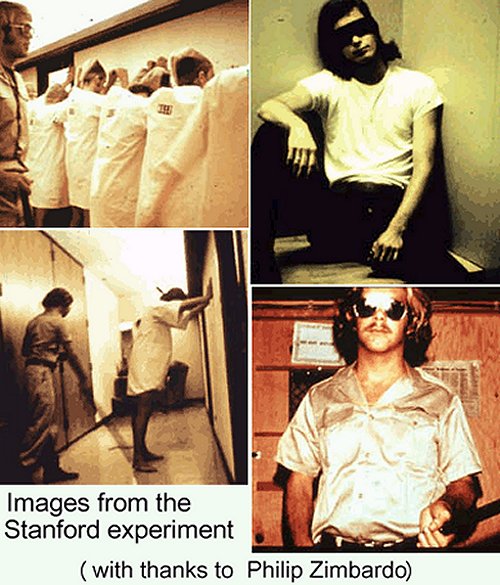
The Stanford Prison Experiment was a study conducted by Stanford University psychology professor Philip Zimbardo to determine the psychological effects of prison life. Participants were screened to be otherwise stable and psychologically healthy and assigned randomly as either “prisoner” or “guard” to live in a two week long prison simulation in the basement of the Stanford psychology building. Guards were given uniforms, mirrored glasses to prevent eye contact, and wooden batons meant only to establish status. Prisoners were dressed in smocks and addressed only by the numbers they were issued. Guards were instructed only to keep a fixed schedule, and that they should attempt to make the prisoners feel powerless, but they could not physically harm them.
The experiment was halted after only six days.
After a prisoner revolt on the second day guards began to display cruel, even sadistic behavior. A system of punishment soon followed including spraying disobedient prisoners with fire extinguishers, depriving them of bedding or restroom privileges, forcing them to go nude and locking them in “solitary confinement” in a dark closet. After the initial revolt, and a brief hunger strike, prisoners on the other hand developed submissive attitudes, accepting physical abuse, and readily following orders from the “guards” to inflict punishments on each other. They even engaged in horizontal discipline to keep each other in line. One prisoner began showing signs of mental breakdown after only 36 hours, yet they stayed even though they were all made aware that they could stop the experiment at any time. As Zimbardo explained, both prisoners and guards had fully internalized their new identities.
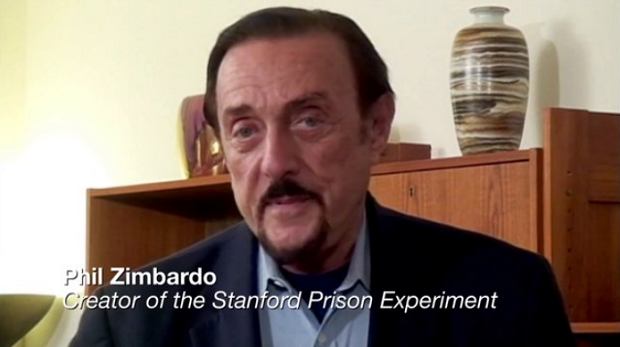
Zimbardo ultimately halted the experiment when he realized that his judgment had been compromised by being sucked in to his role as "Prison Superintendent" and he’d allowed abuse to continue that could be considered torture. His recent book, The Lucifer Effect: Understanding How Good People Turn Evil, details his findings and how they relate to the torture and prisoner abuse at Abu Ghraib.
Ethical concerns raised by these results have made it difficult to repeat these experiments. In fact, under current ethical guidelines it’s almost impossible to study the psychology of power and authority at all. Still, there have been some more recent studies that flesh out the findings of these classic experiments.
What is clear to me from these experiments is that human nature is neither good nor evil, but essentially adaptive. If you take an otherwise good person and invent for them a role that incentivizes evil they will adjust to their new circumstances. And if you internalize “obedience to authority” as a core personality trait you will become capable of the worst forms of murder, and tolerant of the worst forms of abuse.
Power and Deception
Because of the new limitations the more recent experiments on authority are not as dramatic as the previous ones, but the implications of their results are no less startling.
Dana Carney is a professor at Columbia University. She conducted an experiment intended to discover whether “leaders” and “subordinates” experience the same physiological response to lying. She found that power not only makes lying easier, but pleasurable.
Participants from diverse backgrounds were subjected to a personality test that identified them as “leaders” or “subordinates.” In reality the selection was random, but the fake test allowed them to believe their assignment was somehow deserved. Those randomly designated as “leaders” were placed in a large office with an executive desk and given an hour of busy work. Those randomly designated as “subordinates” were placed in a small windowless cubical and given an hour of busy work. After this they engaged in a 10 minute mock negotiation over compensation.
After the mock negotiation half the “leaders” and half the “subordinates” were offered a crisp hundred dollar bill if they could lie to the experimenter in the closing interview and convince him that they didn’t have it. The experimenter did not know who had the money and who didn’t.
For most people lying elicits negative emotions, cognitive impairment, physiological stress, and nonverbal behavioral cues, all of which can be measured. Video of the interviews were reviewed to identify behavioral cues, such as fidgeting or increasing the rate of speech. Saliva samples were tested for increases in the stress hormone cortisol. Tests of reaction time were conducted on the computer to demonstrate cognitive impairment. And a mood survey assessed participants’ emotional states during the experiment.
By every measure liars from the “subordinate” class exhibited all the indicators of deception. They reported negative emotions, demonstrated cognitive impairment, increased stress levels and exhibited behavioral cues associated with lying. Liars from the “leader” class exhibited the exact opposite. By every measure they were indistinguishable from truth-tellers. In fact, it was discovered that they enjoyed reduced levels of stress, increased cognitive function and reported positive emotions. Only “subordinates” reported feeling bad about lying.
Professor Carney speculates that authority could have a similar impact on other unethical behavior with similar physiological responses, such as cheating, stealing, exploitation, reckless behavior and even political corruption. She concludes, “Power will lead to increases in intensity and frequency of lying.”
In other words, lying comes easier, and may be inherently more pleasurable, to those in a position of authority, even fake authority. Also, positions of authority not only attract dishonest people, but actually incentivize dishonesty in people. So, going back to the Stanford Prison Experiment, being a prison guard not only induces cruel and sadistic behavior, but also makes it easier to lie to cover it up. Returning to the Milgrim Experiment, being in a position of subordination induces a willingness to follow unethical orders, but also being in a position of authority may make it easier, even pleasurable, to give unethical orders in the first place.
Power and Compassion
Psychologist Gerben A. Van Kleef from the University of Amsterdam collaborated with colleagues from UC Berkely to conduct an experiment designed to identify how power influences someone’s emotional reactions to the suffering of others.
Unlike the previous experiments we’ve discussed, where participants were randomly selected for “high-power” and “low-power” roles, in this experiment participants from diverse backgrounds filled out a questionnaire about their own sense of power in their actual lives. Subjects were randomly paired off to take turns sharing stories in which they experienced great pain, or emotional suffering.
During the exchange both participants were hooked up to electrocardiogram (ECG) machines which measured stress levels, and after the exchange they all filled out a second questionnaire describing their own emotional experience, and what they perceived of their partner’s emotional experienced.
The results were unmistakable.
For starters, increased stress readings in the story teller correlated with increased stress readings in low-power listeners, but not in high-power listeners. In other words, low-power individuals respond to the suffering of others with emotional reciprocity, but high-power individuals experience greater emotional regulation, or detachment.
According to self-reporting after the experiment, high-power individuals feel less compassion than low-power individuals, which you might expect. But there were other interesting results in the post analysis. High-power listeners were unmotivated to empathize with their partner. In other words, they saw the emotions of others, but they just didn't care. This could explain why high-power listeners don’t experience emotional reciprocity. They simply don’t care about other people’s suffering.
Also, story tellers with high-power listeners reported higher distress than story tellers with low-power listeners. This could indicate that high-power individuals suffer in their interpersonal relationships because their lack of compassion actually exacerbates the suffering of those around them.
After the experiment, researchers inquired about whether participants would like to stay in touch with their partners. As you might expect, the low-power subjects liked the idea, but the high-power subjects didn’t.
Now... lets speculate.
In the Stanford Prison Experiment we saw subjects randomly appointed as “high-power” individuals torture subjects randomly appointed as “low-power” individuals. This research may explain why. Once they had a taste of power they simply no longer experienced reciprocal emotions with those who were powerless. And worse, the lack of compassion of the “guards” would have exacerbated the suffering experienced by the “prisoners.”
How can we apply these findings to the Milgram Experiment scenario, where an authority orders a subordinate to murder a stranger? We already know that 65% of subordinates in that experiment obeyed orders that they viewed as unethical. In this case the authority is the “high-power” individual, the subordinate is the “low-power” individual, and the stranger is the one who suffers. So, we can speculate that the authority will feel less compassion for the suffering of the victim, which would make giving the lethal order easier for him (maybe even pleasurable). But we can also reason that the authority is less likely to feel compassion for the emotional distress of the subordinate. That means that the person making the life or death decision is the one the most cut off from its consequences.
But here’s where it gets sick. The subordinate, a “low-power” individual, has no such emotional detachment. As we saw in the Milgram Experiment, some of the subordinates “exhibited signs of extreme stress.” The subordinate is stuck in the impossible position of both being conditioned to obey the authority, and empathizing with the victim. Is it any wonder why we see high instances of suicide and post-traumatic stress disorder among soldiers, but not among the ranking officers who give them their orders?
Power and Hypocrisy
It has become almost a cliche that the most outspoken anti-gay politicians are in fact closet homosexuals themselves, and the champions of “traditional family values” are engaged in extramarital affairs. Nothing is more common than the fiscal conservative who demands ridiculous luxuries at the taxpayer’s expense, or the anti-war progressive who takes campaign donations from the military industrial complex. Well, now it seems there’s some science behind the hypocrisy of those in power.
Joris Lammers, from Tilburg University, and Adam Galinsky of Kellogg School of Management have conducted a battery of experiments designed to test how having a sense of power influenced a person’s moral standards, specifically whether or not they were likely to behave immorally while espousing intolerance for the behavior of others. In each of five experiments the method of inducing a powerful feeling, and the method of determining these double standards was different, but in every one the results were the same. Powerful people judge others more harshly but cheat more themselves. But what’s especially interesting is his last experiment where distinguishing between legitimate power and illegitimate power garnered the opposite results.

The first experiment was designed to determine the discrepancy between the subject’s expressed standards and their actual behavior. As in previous experiments subjects were randomly assigned to a high-power or low-power class. To induce these feelings “high-power” subjects were asked by experimenters to recall an experience where they felt a sense of power. Meanwhile, “low-power” subjects were asked by experimenters to recall an experience where they felt powerless. Each subject was asked to rate how egregious a moral infraction they considered cheating. Then they were given an opportunity to cheat at dice. They were promised some number of lottery tickets equal to the roll of two dice, and then allowed to self report their roll. The high-power subjects reported considering cheating a higher moral infraction than low-power subjects, but were also more likely to cheat themselves.
In the second experiment participants were made to conduct a mock-government with half randomly given high-power roles which gave orders and half randomly given low-power roles which take orders. Then each group was asked about their feelings about minor common traffic violations, such as speeding, or rolling through stop signs. As expected, high-power subjects were more likely to give themselves permission to the bend the rules if they were running late for an important meeting, but less likely to afford other drivers the same leniency.
In the third experiment participants were divided as in the first experiment, by either recalling a personal experience where they felt powerful or powerless. Then each group was asked about their feelings about minor common tax evasions, such as not declaring freelance income on your taxes. As expected, high-power subjects were more likely to bend the rules for themselves, but less likely to afford others the same leniency.
In the fourth experiment the sense of power was manipulated in an unusual way. All participants were asked to fill out a series of word puzzles. Half the participants were randomly given word searches that contained high-power words, such as “authority” and half were randomly given word searches that contained low-power words, such as “subjugation.” Then all participants were asked about their feelings about keeping a stolen bike that was found abandoned in the road. As in all experiments, even with such a minor insignificant power disparity, those in the high-power group were more likely to say they would keep the bike, but also that others had an obligation to seek out the rightful owner, or turn the bike over to the police.
The fifth and final experiment yielded, by far, the most interesting results of all the experiments we’ve discussed, and it is my hope that this is the direction that this type or research takes in the future. The feeling of power was induced the same as the first and third experiment, where participants were asked to describe their own experience of power in their own life, with one important distinction. In this experiment the “high-power” class was divided into two, one group which was asked to describe an experience where they felt their power was legitimate and deserved, and one group which was asked to describe an experience where they felt their power was illegitimate and undeserved.
The hypocrisy results found in the previous four experiments emerged only when high-power subjects viewed their power as legitimate. Those who viewed their power as illegitimate actually gave the opposite results, a sort of anti-hypocrisy, which researchers dubbed, “hypercrisy.” They were harsher about their own transgressions, and more lenient toward others.
This discovery could be the silver bullet that society has been searching for to put down the werewolf of political corruption. The researchers speculate that the vicious cycle of power and hypocrisy could be broken by attacking the legitimacy of power, rather than the power itself. As they write in their conclusion:
“A question that lies at the heart of the social sciences is how this status-quo (power inequality) is defended and how the powerless come to accept their disadvantaged position. The typical answer is that the state and its rules, regulations, and monopoly on violence coerce the powerless to do so. But this cannot be the whole answer...
Our last experiment found that the spiral of inequality can be broken, if the illegitimacy of the power-distribution is revealed. One way to undermine the legitimacy of authority is open revolt, but a more subtle way in which the powerless might curb self enrichment by the powerful is by tainting their reputation, for example by gossiping. If the powerful sense that their unrestrained self enrichment leads to gossiping, derision, and the undermining of their reputation as conscientious leaders, then they may be inspired to bring their behavior back to their espoused standards. If they fail to do so, they may quickly lose their authority, reputation, andâ€" eventuallyâ€"their power.
We have seen that those given power are more likely to lie, cheat and steal with impunity while also being harsher in their judgments of others for doing these things. We have seen that those given power feel less compassion for the suffering of others, and are even capable of the torture and murder of innocent people. What’s perhaps most disturbing is that we have seen that these sociopathic tendencies have been fostered in otherwise psychologically healthy people. In other words, the problem is not that sociopaths are drawn to positions of authority, but that positions of authority draw out the sociopath in everyone. But this final experiment offers some hope that authoritarian sociopathy can not only be stopped, but driven into reverse, not by violence or revolution, but simply by undermining their sense of legitimacy.
Reclaiming Lost Ground
Nothing has changed the public’s perception of the legitimacy of authority more than the Stanford Prison Experiment and the Milgram Experiment. Yet, even those who eagerly trumpet the results of those experiments have likely never heard of this other research. Because of the changes to the ethical guidelines research on authority has been neutered. It is far less dramatic, and as a result has had much less impact on the culture. The study of authoritarian sociopathy has been relegated to the water cooler banter of academics, where it’s disruptive power is minimized.
As anarchists and libertarians we must be willing to do whatever it takes to manifest a free society, even if it’s illegal, as long as it’s ethical. If the illegitimate ethical guidelines of legacy institutions hamstring meaningful research on authoritarian sociopathy then it is time for us to cast off such restrictions, and devise our own guidelines consistent with our own ethics. If court professors will not spread their findings beyond their classrooms and peer reviewed journals then it is time to conduct our own renegade psychological experiments, to show the world beyond doubt that power corrupts absolutely.
To win the battle for freedom we must reclaim the ground where the legitimacy of tyranny hides: the mind.
About the Author
Davi Barker is a writer, artist, merchant, and speaker but more importantly he is an advocate of peace, independence and liberation from the State. A street activist in the both the Tea Party and Occupy Movement, Davi has embraced rejected the W2 9-to-5 world in favor of full time Agorism. He is the editor of DailyAnarchist.com, the Campaign Navigator of BitcoinNotBombs.com, the proprietor of ShinyBadges.com, a marketing agent for SilverCircleMovie.com and the assistant director or Muslims4Liberty.org.
If you are interested in supporting or collaborating on the first renegade psychological experiment you can contact the author at Davi@BitcoinNotBombs.com