
Now is the time to order bare root trees online or at your local nursery. In fact, in many nurseries it is already too late. Others will cut off ordering sometime in December. Delivery will take place now through March depending upon your climate zone.
What are bare root trees (or bareroot)?
Trees are grown for two to four years and hedgerows at a wholesale nursery. When they are dormant they are cut out of the ground using a mechanical root cutter, ripped from the ground and then cut to around four feet in length. Usually striped of any branches and leaving only the major roots trimmed up for shipping. Tree abuse.
Why would I want to buy bare root trees?
Those containerized plants you buy at your retail nursery are likely to have been shipped bare root to them and potted. Bare root trees seem to have a higher success rate in planting than containerized trees of the same species. Possibly because they go from a tree farm's soil to your soil rather than from the enriched potting soil of a container to your soil. They are not only usually less expensive than container trees but much lower shipping costs. And many more varieties are offered.
But for all of your money you end up with a box full of sticks.
Successful planting depends upon how you treat your newly arrived trees. It is pretty simple really...the quicker you get them in the ground the better the chances the tree will survive and thrive.
You want to plant them before they emerge from dormancy. Store them outside in the shade. You want them to stay cold, but not to freeze.
Care on arrival
When they arrive in their container the trees will typically survive up to one week without unpacking. It is critical the roots never be allowed to dry out. The roots are usually wrapped up in a hydrated gel, moist sawdust, newspaper or moss. Rehydrate if necessary. If you cannot plant them withing five days of arrival it is best to "heel" them in (discussed below).
I would encourage you to have already dug your holes for planting before the trees arrive. And unpack your trees when you are ready to start planting, inventory and inspect them and then carefully pull two or three trees out and put them in a bucket of root stimulating water and carefully re-wrap the rest. You want to avoid damaging the already traumatized roots in separating the trees.
There should be the smells of soil, not any rotten odors. Plants and packaging should be relatively mold and mildew free; a little mold is alright but the more mold on the plant the less your chances of success.
Do not cut any roots unless they are damaged or unhealthy and then remove them with a single clean cut. You are already missing a lot of the root system don't remove good roots.
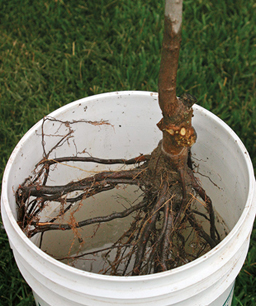
Soak the roots of the bare root trees five to ten minutes in a 5 gallon bucket filled with water containing
Vitamin B-1 (or other root stimulant) per directions. This also serves to remove the hydrating gel from the roots which needs to be removed before planting. [Some people say to soak the roots one hour to up to seven hours before planting. I am concerned about drowning the roots even if dormant with this much time. I suspect this means however it is okay if the roots sit in this bucket of water a while until you are ready to plant them. But I don't think it is necessary to soak for the sake of soaking.]
Planting
Fruit trees require a location with good drainage and full sunlight (six hours a day) to produce acceptable fruit.
Dig a hole at least twice the diameter of the roots and as deep. You want the level of the hole to be where the tree was when it was originally grown. You can certainly see where this level was above the roots as the air exposed bark demarcation should be evident. Make a cone of compacted dirt in the center and bottom of the hole and spread the roots as evenly as possible around this cone before filling in around the tree with dirt. I like to have stuck the shovel blade down a foot further in the bottom and waggle it to loosen up the soil around in the hole, but not where the cone will be unless the tree is one of the few that sends down a tap root. I also scar the sides of the hole with the shovel blade. This loosening and shoveling is to both assist water drainage and the roots later in penetrating further out from the hole. Generally you don't loosen up directly under the tree so it won't settle deeper later. Orient any flat side of the graft union towards the east to minimize future sun burn on this area.
Be sure to carefully and gently pack the dirt in around the roots so there are no air pockets around the roots. Add water if necessary to pack the dirt down and continue filling the hole. Never bury so deep as to bury the graft point of the rootstock will send up numerous suckers and overwhelm the variety you selected.
If you have good soil you need not add amendments generally. However different species require or prefer some amendments. Read any instructions that came from the supplier. Bad soil either must be replaced with good soil or planted in raised beds with good soil.
Construct a water holding basin around the tree.
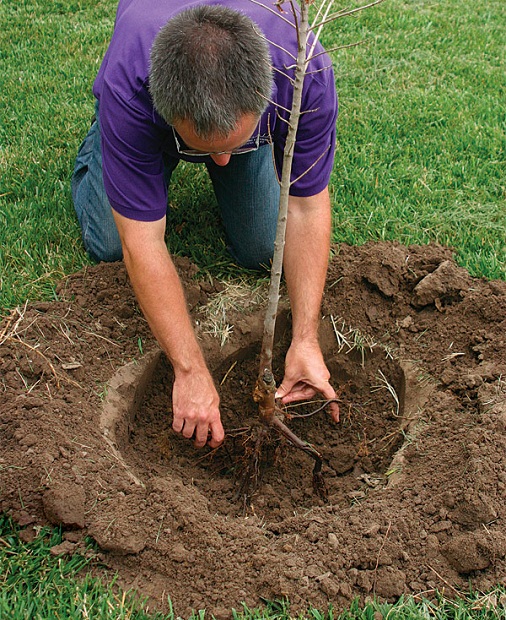
Water to saturate the area. I usually use the vitamin B-1 water in a bucket. Generally don't water again until buds are seen unless the soil gets dry (screw driver only inserts into ground 6 inches).
Staking is unnecessary unless it is a windy area and even harmful as the tree needs to deal with winds by building up its trunk. Something it won't do with the crutch of a stake supporting it.
Heeling-In
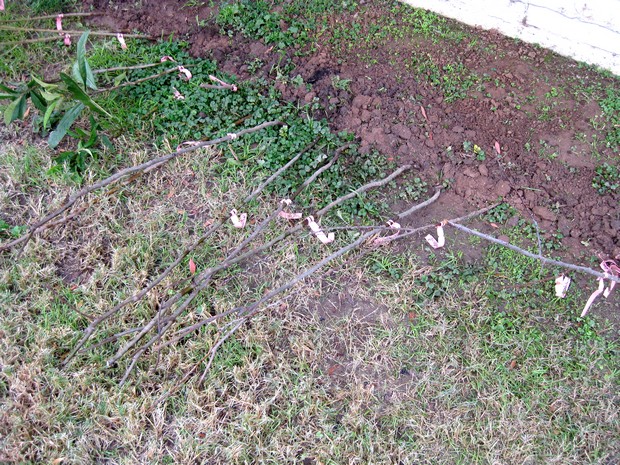
If for any reason you cannot get the trees planted withing a week (five days to be safe) you must either refrigerate the trees (impractical for most) or bury the roots (called "heeling in"). Pick a shaded cool spot (the north side of the home in the northern hemisphere) safe from freezing. Dig a V-shaped trench in which the V is laying somewhat on its side. You want to lay the tree in so it is about 45 to 30 degrees up off of the ground with all of the roots buried in the trench. Burying them close to the house and at a shallow angle will help prevent any freezing and keep the wind from disturbing them. Cover the roots, air pockets are okay as long as the roots are completely covered. Water well. Must stay moist. Don't let the roots ever dry out. Can be heeled in for up to three months. But best to get on with planting them as soon as possible so something doesn't go wrong and before they come out of dormancy.
Painting, tree wrap
While dormant is the perfect time to prune. When trees are planted, as a rule for homeowners deciduous trees should be cut to about 30 inches from the surface. Don't worry they will grow out. If branches are present they can be pruned back by half to two-thirds, or removed entirely to create the desired form. Evergreens are usually not touched unless to remove damaged limbs.
Paint all bare trees with a 50% (diluted with water) exterior white water based [it will say 'you can clean the brushes with water'] latex paint. This protects them from sun and from evaporation. Don't worry, buds will push their way out just fine.
You can loosely wrap the trunk in newspaper or some other (not plastic) covering to protect them from freezing or sun burn. And a good wrap or a plastic pipe around the trunk can prevent weed eater or mower damage to the tender trunk.
Anti-transpirant
It is a good idea to apply an anti-transpirant to the tree, but not the roots. This can be mixed in with the paint or applied later. And anti-transpirant is a moisture control agent, sort of a plastic coating that helps prevent water loss. This helps recover from transplant shock.
There are several to choose from, I happen to use Moisturin (GSI Horticultural) but any will work.
Mulch
With freezing ground temperatures heavy mulching is needed, as well as high temperature situations (soil above 85 degrees). Four to eight inches deep layer. Keep mulch around 8 inches away from the trunk to prevent fungal infection or pests from attacking bark. When freezing is over, move the mulch away from tree temporarily to allow soil to warm up. Move back when heat and evaporation become a problem. The tree should have nicely broken dormancy by then.
Mulch with an organic substance: leaves, bark or compost. Rock, plastic and shredded tire should be avoided except in the coldest regions.
Pests (gophers, moles, rabbits and deer)
Some mammals love tender new trees. Especially the roots or new growth. Fencing can keep rabbits and deer at bay. Fencing (1/4"mesh) buried down to 18 inches can keep burrowing rodents out.
Nematodes can damage some newly planted trees. If this is a problem consult your local County Exchange for a solution.
Budding
If budding fails when expected the entire tree can be dug up and buried whole in that cool spot you reserved for your heeling-in. Hopefully after a few days it can be dug up and replanted leading to bud break. This trick will only work if it needed a hundred or so more hours of chill before leaving dormancy and it also serves to rehydrate the whole tree.
Not all trees should be bare rooted. Some that send out a tap root are not suited to be delivered as a bare root. Nor are trees with sensitive roots such as papayas, mangoes, citrus, pomegranates and figs. If you have your heart set on a species and you can't find anyone selling it bare rooted this may be why.
Powell Gammill is a certified Permaculture Design Consultant whose interests lie in creating an environment in which food is grown to benefit families and drawing neighbors together. Where dependency on outside resources is diminished. And whose properties are improved over time with use rather than being depleted.


 Feature Article • More about


