



News Link • Treasury
The Long Bond Just Hit Pre-2008 Financial Crisis Levels--And Even Iran Is Noticing
• https://www.crisisinvesting.com, Lau VegysThis week, the U.S. Treasury auctioned $25 billion of 30-year bonds at a yield of 5.046%.
That number doesn't sound like much. Until you realize it's the first time a 30-year auction has cleared above 5% since 2007.
In fact, the prints were so bad that Iran's parliament speaker, Mohammad Ghalibaf, took to X to mock the U.S.
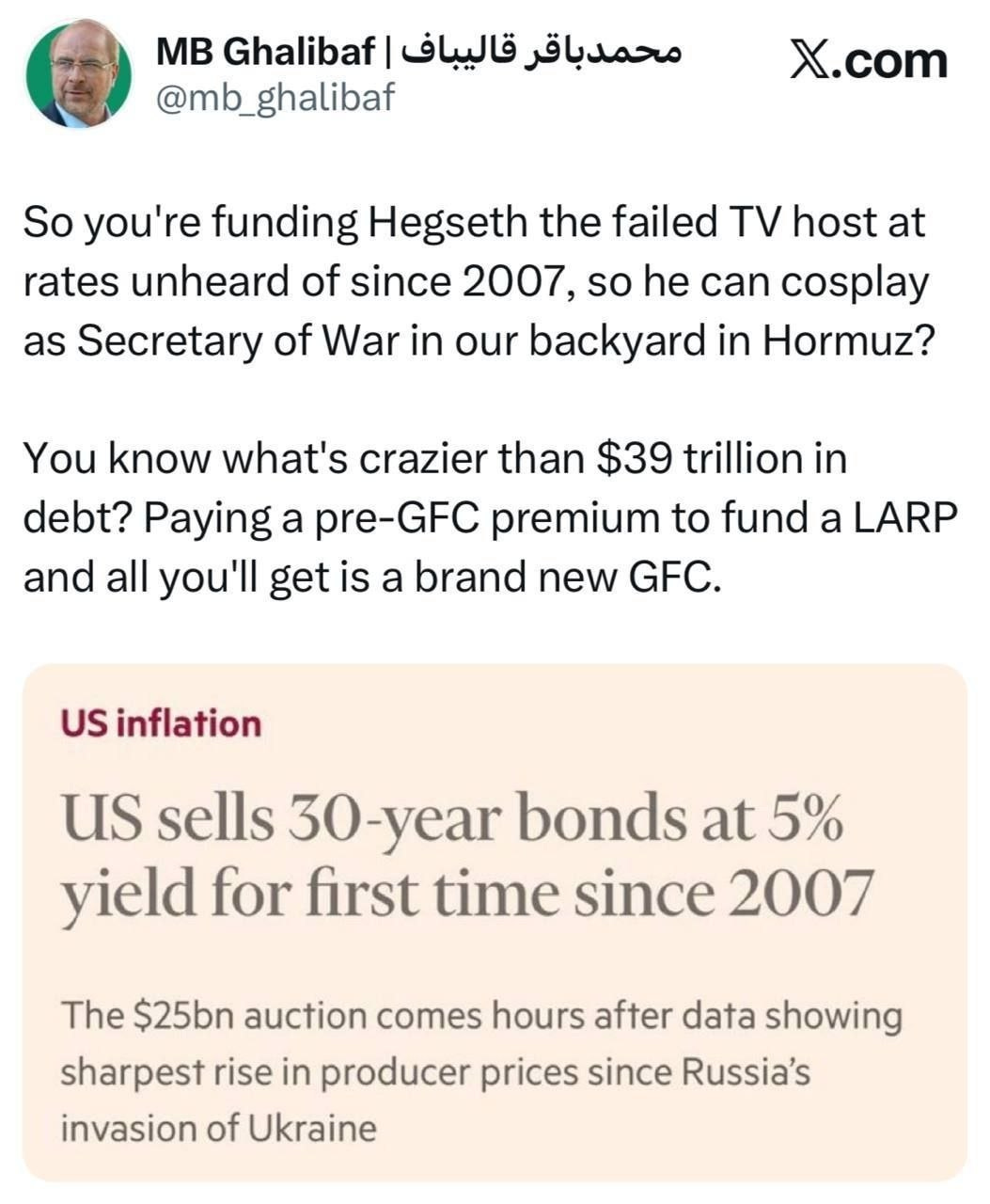
Source: X
As a result, here's what the chart of the 30-year yield looks like right now.
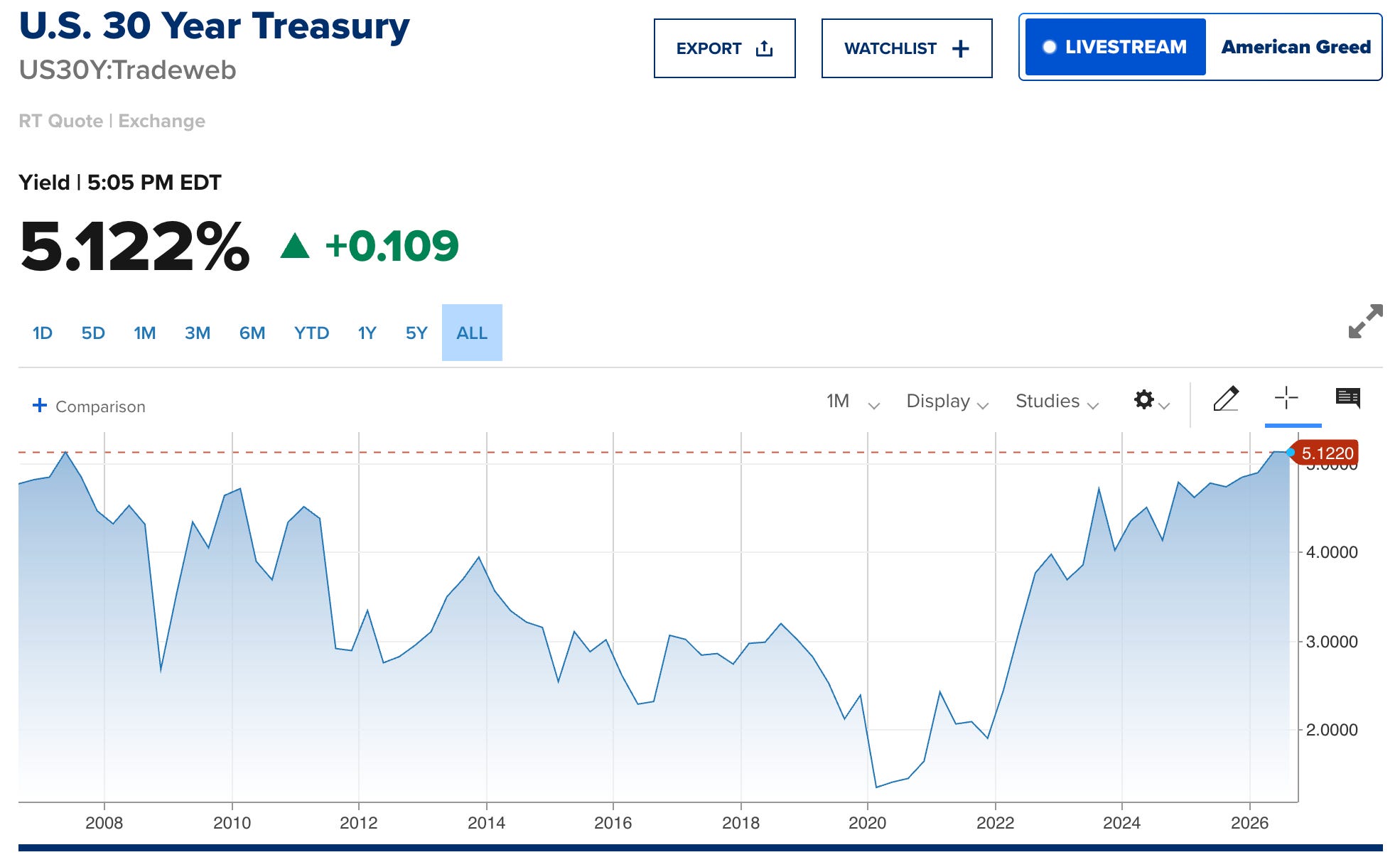
Source: CNBC
That's 5.12% as of this morning — the highest the long end of the Treasury curve has been since the run-up to the 2008 global financial crisis.
For those not glued to bond markets, here's why that matters. The 30-year Treasury yield is the price the U.S. government pays to borrow money for thirty years — the longest term it issues. It's also the benchmark that anchors every other long-term interest rate in the economy: mortgages, corporate debt, pension fund discount rates. When it rises, every one of those goes up with it. Including the cost of the government's own debt.
And the U.S. government has a lot of debt — $39 trillion of it.
Trouble is, interest expense alone is running at roughly $1 trillion a year — more than the entire military budget. Already on par with Medicare. Second only to Social Security. And every 1% increase in the average borrowing cost adds roughly $390 billion a year at this debt level.
That's a huge problem. Because as I wrote earlier this week, the government's own numbers project federal debt hitting $65 trillion by 2036. Not a generation. A decade.
Paying that much interest on that much debt is how governments go broke.
But the U.S. can't actually default the normal way. Reserve-currency status, the petrodollar, the entire postwar system — not to mention the precious careers of those at the top. Too much breaks if Treasury debt isn't money-good.


