


IPFS

Ray McGovern: My Take
Ray McGovern
More About: LibyaThe Real Blame for Deaths in Libya
By Ray McGovern
If you prefer charade to reality, inquisition to investigation, trees over forest – the House Government Oversight Committee hearing last Tuesday on “Security Failures of Benghazi” was the thing for you.
The hearing was the latest example of the myopic negligence and misfeasance of elected representatives too personally self-absorbed – and politically self-aggrandizing – to head off misbegotten wars and then too quick to blame everyone but themselves for the inevitable blowback.
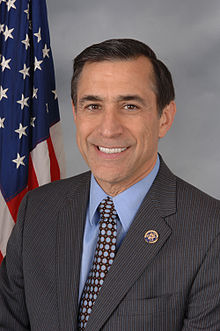
Rep. Darrell Issa, R-California, chairman of the House Committee on Oversight.
“So what’s the problem?” a friend asked, as I bemoaned the narrowly focused, thoroughly politicized charges and countercharges at the hearing. “It’s just a few weeks before the election; it’s high political season; I found the whole farce entertaining.”
The problem? One is that the partisan one-upmanship of committee chair Rep. Darrell Issa, R-California, and others soft-pedaled the virtual certainty that the murder of four American officials in Libya on Sept. 11, 2012, was a harbinger of more such killings to come. Worse still, few of the committee members seemed to care.
As I listened to the inane discussion, I wanted to shout: “It’s the policy, stupid!” The tightest security measures reinforced by squads of Marines cannot compensate for the fallout from a stupid policy of bombing and violent “regime change” in Libya and elsewhere in the Muslim world.
While joining with others in bemoaning State’s repeated refusal to honor pleas from the field for additional security in Libya, Nordstrom admitted that, even with additional security forces, the attack would not have been prevented. Nordstrom, a 14-year veteran of State’s Diplomatic Security Service, was quite specific:
“Having an extra foot of wall, or an extra half-dozen guards or agents would not have enabled us to respond to that kind of assault,” Nordstrom said. “The ferocity and intensity of the attack was nothing that we had seen in Libya, or that I had seen in my time in the Diplomatic Security Service.”
For any but the most partisan listener this key observation punctured the festive, Issa/Chaffetz carnival balloon that had assigned most of the blame for the Benghazi murders to bureaucratic indifference of State Department functionaries in Washington.
Also falling rather flat were partisan attempts to exploit understandable inconsistencies in earlier depictions of the Benghazi attack and twist them into a soft pretzel showing that the Obama administration is soft on terrorism or conducting a “cover-up.”
There is also the reality that diplomatic service in hostile parts of the world is never safe, especially after U.S. policy has stirred up or infuriated many of “the locals.” For decades, as populations have chafed under what they regard as U.S. military and political interference, U.S. embassies and other outposts have become targets for attacks, some far more lethal than the one in Benghazi.
To recall just a few such incidents: Iranian resentment at longtime U.S. support for the Shah led to the seizure of the U.S. Embassy in Tehran under President Jimmy Carter; anger at U.S. involvement in Lebanon led to bombings of the U.S. Embassy and a U.S. Marine barracks killing more than 300 under President Ronald Reagan; U.S. embassies in Africa were bombed under President Bill Clinton; and the violence was brought to the U.S. mainland on 9/11 and also against numerous U.S. facilities in Afghanistan and Iraq under George W. Bush.
John Brennan, the Avenger
However, in this political season, the Republicans want to gain some political advantage by stirring up doubts about President Barack Obama’s toughness on terrorism – and the Obama administration is looking for ways to blunt those rhetorical attacks by launching retaliatory strikes in Libya or elsewhere.
Thus, it was small comfort to learn that Teflon-coated John Brennan, Obama’s counterterrorism adviser, had flown to Tripoli, hoping to unearth some interim Libyan government officials to consult with on the Benghazi attack. With the embassy’s help, he no doubt identified Libyan officials with some claim to purview over “terrorism.”
But Brennan is not about investigation. Retribution is his bag. It is likely that some Libyan interlocutor was brought forth who would give him carte blanche to retaliate against any and all those “suspected” of having had some role in the Benghazi murders.
So, look for “surgical” drone strike or Abbottabad-style special forces attack – possibly before the Nov. 6 election – on whomever is labeled a “suspect.” Sound wild? It is. However, considering Brennan’s penchant for acting-first-thinking-later, plus the entrée and extraordinary influence he enjoys with President Obama, drone and/or special forces attacks are, in my opinion, more likely than not. (This is the same Brennan, after all, who compiles for Obama lists of nominees for assassination by drone.)
If in Tuesday’s debate with ex-Massachusetts Gov. Mitt Romney, Obama is pressed, as expected on his supposed weakness in handling Benghazi, attacks on “terrorists,” real or “suspect,” become still more likely. Brennan and other White House functionaries might succeed in persuading the President that such attacks would be just what the doctor ordered for his wheezing poll numbers.
But what about tit-for-tat terrorist retaliation for those kinds of attacks? Not to worry. With some luck, the inevitable terrorist response might not be possible until after the voting. Obama’s advisers would hardly have to remind him of the big but brief bounce after killing al-Qaeda leader Osama bin Laden.
Mindless vengeance has been a popular political sell since 9/11. And so have drones. Both dovetail neatly with Brennan’s simplistic approach to terrorism; namely, just kill the “bad guys” – the comic-book moniker so often used for “suspected” militants, terrorists, insurgents and still other folks with an enduring hatred for America.
Where is Helen Thomas when we need her! She was the only journalist not to genuflect before Brennan’s inanities, and had the temerity to ask him directly to explain what motivates terrorists.
At an awkward press conference on Jan. 7, 2010, two weeks after Umar Farouk Abdulmuttalab (the so-called “underwear bomber”) slipped through Brennan’s counter-terrorism net and nearly brought down an airliner over Detroit, Helen Thomas tried to move the discussion beyond preventive gimmicks like improved body-imaging scanners and “behavior detection officers” at airports. She asked Brennan about motivation; why did Abdulmuttalab do what he did.
Thomas: “And what is the motivation? We never hear what you find out on why.”
Brennan: “Al Qaeda is an organization that is dedicated to murder and wanton slaughter of innocents. … They attract individuals like Mr. Abdulmutallab and use them for these types of attacks. He was motivated by a sense of religious sort of drive. Unfortunately, al-Qaeda has perverted Islam, and has corrupted the concept of Islam, so that he’s (sic) able to attract these individuals. But al Qaeda has the agenda of destruction and death.”
Thomas: “And you’re saying it’s because of religion?”
Brennan: “I’m saying it’s because of an al-Qaeda organization that used the banner of religion in a very perverse and corrupt way.”
Thomas: “Why?”
Brennan: “I think this is a – long issue, but al-Qaeda is just determined to carry out attacks here against the homeland.”
Thomas: “But you haven’t explained why.”
Seldom does anyone have the guts to explain why. There is virtually no adult discussion in our mass media about the underlying causes of terrorism. We are generally asked to take it on faith that many Muslims are hardwired at birth or through appeals to their Islamic faith to “hate America.” And, as Brennan would have us believe, that’s why they resort to violence.
Chickens Home to Roost
It was no surprise, then, that almost completely absent from the discussion at last Tuesday’s hearing was any attempt to figure out why a well-armed, well-organized group of terrorists wanted to inflict maximum damage on the U.S. consulate in Benghazi and kill the diplomats there.
Were it not for Rep. Dennis Kucinich, D-Ohio, impressionable listeners would have been left with the idea that the attack had nothing to do with Washington’s hare-brained, bomb-heavy policies, from which al-Qaeda and similar terrorist groups are more beneficiary than victim, as in Libya.
Not for the first time, Kucinich rose to the occasion at Tuesday’s hearing:
“You’d think that after ten years in Iraq and after eleven years in Afghanistan that the U.S. would have learned the consequences and the limits of interventionism. … Today we’re engaging in a discussion about the security failures of Benghazi. The security situation did not happen overnight because of a decision made by someone at the State Department. …
“We owe it to the diplomatic corps, who serves our nation, to start at the beginning and that’s what I shall do. Security threats in Libya, including the unchecked extremist groups who are armed to the teeth, exist because our nation spurred on a civil war destroying the security and stability of Libya. … We bombed Libya. We destroyed their army. We obliterated their police stations … Al Qaeda expanded its presence.
“Weapons are everywhere. Thousands of shoulder-to-air missiles are on the loose. Our military intervention led to greater instability in Libya. … It’s not surprising that the State Department was not able to adequately protect our diplomats from this predictable threat. It’s not surprising and it’s also not acceptable. …
“We want to stop attacks on our embassies? Let’s stop trying to overthrow governments. This should not be a partisan issue. Let’s avoid the hype. Let’s look at the real situation here. Interventions do not make us safer. They do not protect our nation. They are themselves a threat to America.”
Congressman Kucinich went on to ask the witnesses if they knew how many shoulder-to-air missiles were on the loose in Libya. Nordstrom: “Ten to twenty thousand.”
And were the witnesses aware of al-Qaeda’s growing presence in Libya, Kucinich asked. One of the witnesses, Lt. Col. Andrew Wood, an Army Green Beret who led a 16-member Special Forces security team to protect Americans in Libya from February to August, replied that al-Qaeda’s “presence grows every day. They are certainly more established than we are.”
Bottom line: Americans are not safer; virtually no one is safer because of what the United States did to Libya to remove the regime of Muammar Gaddafi. Q.E.D.
I was able to listen to most of the hearing on my car radio, and found it difficult to contain my reaction to the farce. So I was glad to get a call from RT TV, asking me to come at once to the studio and comment on the RT news program at 5:00 p.m. I cannot say I enjoyed trying to draw out the dreary implications. But, in this case, they were clear enough to enable “instant analysis.” And those ten minutes on camera were, for me, like lancing a boil.
Dead Consciences
We are told we should not speak ill of the dead. Dead consciences, though, should be fair game. In my view, the U.S. Secretary of State did herself no credit the morning after the killing of four of her employees, when she said:
“I asked myself – how could this happen? How could this happen in a country we helped liberate, in a city we helped save from destruction? This question reflects just how complicated and, at times, how confounding the world can be. But we have to be clear-eyed, even in our grief.”
But some things are confounding only to those suppressing their own responsibility for untold death and misery abroad. Secretary Clinton continues to preen about the U.S. role in the attack on Libya. And, of Gaddafi’s gory death, she exclaimed on camera with a joyous cackle, “We came; we saw; he died.”
Can it come as a surprise to Clinton that this kind of attitude and behavior can set a tone, spawning still more violence?
The Secretary of State may, arguably, be brighter than some of her immediate predecessors, but her public remarks since the tragedy at Benghazi show her to be at least as equally bereft of conscience as Condoleezza Rice, Colin Powell, and yes-we-think-the-price-of-a-half-million-Iraqi-children-dead-because-of-our-sanctions-is-worth-it Madeleine Albright.
Like Albright, Clinton appears to suffer from Compassion Deficit Disorder (CDD), especially when it comes to people who do not look like most Americans. (She does make occasional exceptions for annoying people like me who also merit her disdain).
Given that she is plagued with CDD, it would have been too much to expect, I suppose, for Clinton to have taken some responsibility for the murder of four of her employees – much less the killing, maiming and destruction caused by the illegal attack on Libya. But if she really wants to get “clear-eyed,” holding herself accountable would be a good start.
Was it dereliction of duty for Clinton to have failed to ensure that people working for her would honor urgent requests for security reinforcement in places like Benghazi? I believe it was. The buck, after all, has to stop somewhere.
In my view, counterterrorism guru Brennan shares the blame for this and other failures. But he has a strong allergy to acknowledging such responsibility. And he enjoys more Teflon protection from his perch closer to the President in the White House.
The back-and-forth bickering over the tragedy in Benghazi has focused on so many trees that the forest never came into view. Not only did the hearing fall far short in establishing genuine accountability, it was bereft of vision. Without vision, the old proverb says, the people perish – and that includes American diplomats.
The killings in Benghazi on Sept. 11, 2012, validate that wisdom. If the U.S. does not change the way it relates to the rest of the world, and especially to the Muslim world, more and more people will perish.
If we persist on the aggressive path we are on, Americans will in no way be safer. As for our diplomats, in my view it is just a matter of time before our next embassy, consulate or residence is attacked.
Role of Congress
It is a lot easier, of course, to attack a defenseless Muslim country, like Libya, when a supine House of Representatives forfeits the prerogative reserved to Congress by the Constitution to authorize and fund wars – or to refuse to authorize and fund them.
At Tuesday’s hearing, Kucinich noted that in Libya “we intervened, absent constitutional authority.” Most of his colleagues reacted with the equivalent of a deep yawn, as though Kucinich had said something “quaint” and “obsolete.” Like most of their colleagues in the House, most Oversight Committee members continue to duck this key issue, which directly involves one of the most important powers/duties given the Congress in Article I of the Constitution.
Such was their behavior last Tuesday, with most members preferring to indulge in hypocritical posturing aimed at scoring cheap political points. Palpable in that hearing room was one of the dangers our country’s Founders feared the most – that, for reasons of power, position and money, legislators might eventually be seduced into the kind of cowardice and expediency that would lead them to forfeit their power and their duty to prevent a president from making war at will.
Many of those now doing their best to make political hay out of the Benghazi “scandal” are the same legislators who appealed strongly for the U.S. to bomb Libya and remove Gaddafi. This, despite it having been clear from the start that eastern Libya had become a new beachhead for al-Qaeda and other terrorists. From the start, it was highly uncertain who would fill the power vacuums in the east and in Tripoli.
In short, Oversight Committee members were among those in Congress who thought war on Libya was a great idea, with many criticizing Obama for not doing more, sooner, for “leading from behind” rather than “leading from the front.” Now, they’re making cheap political points from the consequences of a war for which they strongly pushed.
War? What War?
As Congress failed to exercise its constitutional duties – to debate and vote on wars – Obama, along with his Defense Secretary Leon Panetta and Hillary Clinton, took a page out of the Bush/Cheney book and jumped into a new war. Just don’t call it war, said the White House. It’s merely a “kinetic humanitarian action.”
You see, our friends in Europe covet that pure Libyan oil and Gaddafi had been a problem to the West for a long time. So, it was assumed that there would be enough anti-Gaddafi Libyans that a new “democratic” government could be created and talented diplomats, like Ambassador Christopher Stevens, could explain to “the locals” how missiles and bombs were in the long-term interest of Libyans.
On Libya, the Obama administration dissed Congress even more blatantly than Cheney and Bush did on Iraq, where there was at least the charade of a public debate, albeit perverted by false claims about Iraq’s WMD and Saddam Hussein’s ties to al-Qaeda.
And so Defense Secretary Panetta and Secretary of State Clinton stepped off cheerily to strike Libya with the same kind of post-war plan that Cheney, Bush, and then-Defense Secretary Donald Rumsfeld had for Iraq – none.
Small wonder chaos reigns in Benghazi and other parts of the country. Can it be that privileged politicians like Clinton and Panetta and the many “one-percenters” in Congress and elsewhere really do not understand that, when the U.S. does what it did to Libya, there will be folks who don’t like it; that they will be armed; that there will be blowback; that U.S. diplomats, given an impossible task, will die?
Libya: Precedent for Syria
Constitutionally, the craven Congress is a huge part of the problem. Only a few members of the House and Senate seem to care very much when presidents act like kings and send off troops drawn largely by a poverty draft to wars not authorized (or simply rubber-stamped) by Congress.
Last Tuesday, Kucinich’s voice was alone crying in the wilderness, so to speak. (And, because of redistricting and his loss in a primary that pitted two incumbent Democrats against each other, he will not be a member of the new Congress in January.)
This matters – and matters very much. At a hearing of the Senate Armed Services Committee on March 7, Sen. Jeff Sessions, R-Alabama, pursued this key issue with Panetta and Joint Chiefs Chairman Gen. Martin Dempsey.
Chafing ex post facto at the unauthorized nature of the war in Libya, Sessions asked repeatedly what “legal basis” would the Obama administration rely on to do in Syria what it did in Libya.
Watching that part of the testimony it seemed to me that Sessions, a conservative Southern lawyer, was not at all faking when he pronounced himself “almost breathless,” as Panetta stonewalled time after time. Panetta made it explicitly clear that the administration does not believe it needs to seek congressional approval for wars like Libya. At times he seemed to be quoting verses from the Book of Cheney.
Sessions: “I am really baffled … The only legal authority that’s required to deploy the U.S. military [in combat] is the Congress and the President and the law and the Constitution.”
Panetta: “Let me just for the record be clear again, Senator, so there is no misunderstanding. When it comes to national defense, the President has the authority under the Constitution to act to defend this country, and we will, Sir.”
(If you care about the Constitution and the rule of law, I strongly recommend that you view the entire 7-minute video clip.)
Lawyers all: Sessions, Panetta, Hillary Clinton, Obama. In my view, the latter three need to be called out on this. If they see ambiguity in Article I, Section 8 of the Constitution, they should explain the reasoning behind their flexible interpretation.
Cannot the legal profession give us some clarity on this key point before legally trained leaders with a penchant for abiding by the Constitution only when it suits them take our country to war in Syria without the authorization of our elected representatives?
Ray McGovern works with Tell the Word, a publishing arm of the ecumenical Church of the Saviour in inner-city Washington. He served as an Army infantry/intelligence officer and then a CIA analyst for a total of 30 years, and now serves on the Steering Group of Veteran Intelligence Professionals for Sanity (VIPS).


