


 Trillion AIG Tarp billions millions currency denomination mint stimulus bill gates berkshire
IPFS
What Does $1 Trillion Look Like?
Written by Thomas Costanzo Subject: Economy - Economics USAWhat Does $1 Trillion Look Like? By Paul Toscano Graphic: Paul Alvord for CNBC.com
Throughout the financial crisis, huge sums of money have been spent,
handed out and lost. With talk of billions upon billions being passed
around, it’s easy to lose perspective on how much $1 trillion or even
$1 billion really is.
With official measurements of American currency from the US Bureau of Printing and Engraving and the US Mint, here’s some perspective on what these huge sums of money would actually look like and how they would compare to every day objects.
What would the money allocated to the TARP actually look like? How high would the AIG bonuses pile up if the bills were stacked one on top of another? How big, literally, is the National Debt?
With official measurements of American currency from the US Bureau of Printing and Engraving and the US Mint, here’s some perspective on what these huge sums of money would actually look like and how they would compare to every day objects.
What would the money allocated to the TARP actually look like? How high would the AIG bonuses pile up if the bills were stacked one on top of another? How big, literally, is the National Debt?
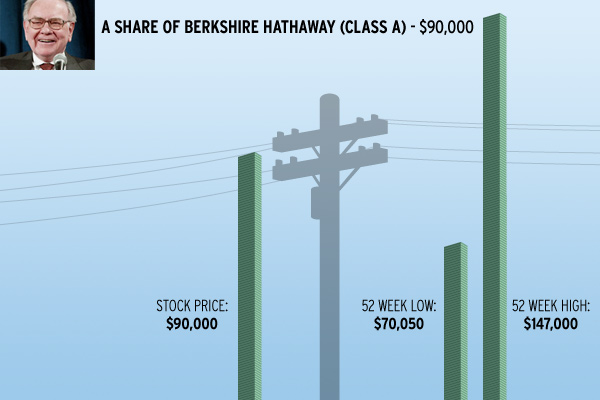
Share Price: $90,000
52 Week high: $147,000
52 Week low: $70,050
A
single share of Class A Stock of Berkshire Hathaway, the holding
company of Warren Buffett, is among the priciest individual stocks
traded on the market. If one share at current market value of $90,000
(as of 4/2/09) was converted into $1 bills, the column of cash would
rise 32 feet, approximately 3/4 the height of a standard American
utility pole (40 ft).
The 52 week high of $147,000 (9/19/08)
would stack 10 feet above a standard utility pole, while the stock’s 52
week low (3/5/09) would measure 25 feet in $1 bills, a little more than
half the height of the pole.
One Share Berkshire Hathaway stock Class A ($90,000)
 The 2008 AIG Bonuses (prior to their promised return to the US
government), if denominated in $100 bills, would measure 591 feet,
stretching approximately 40 feet above the height of the Washington
Monument.
The 2008 AIG Bonuses (prior to their promised return to the US
government), if denominated in $100 bills, would measure 591 feet,
stretching approximately 40 feet above the height of the Washington
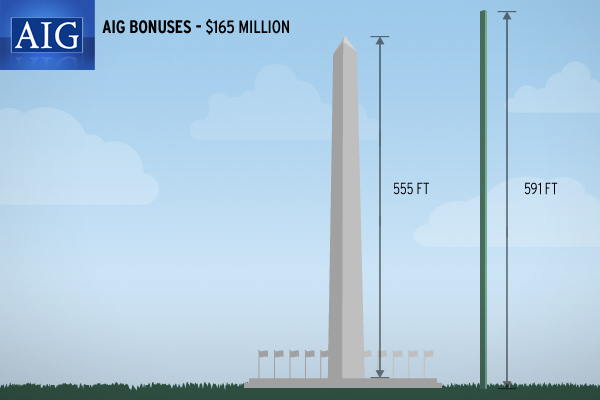
Monument. If denominated in $1 bills, laid one on top of another, the stack would measure 59,125 feet, extending into the stratosphere and topping off at the lower extreme of the Ozone layer. It would stretch to more than twice the altitude of the highest clouds in the sky, and the stack would approach the service ceiling of an F-22 Raptor fighter jet.
AIG Bonuses - $165 Million
 This year, Bill Gates was once again named the world’s richest man by
Forbes, with a net worth of $40 billion. If this amount was denominated
in $1 bills, this stack would measure about 2,714 miles, which is
approximately the distance between Miami and Seattle.
This year, Bill Gates was once again named the world’s richest man by
Forbes, with a net worth of $40 billion. If this amount was denominated
in $1 bills, this stack would measure about 2,714 miles, which is
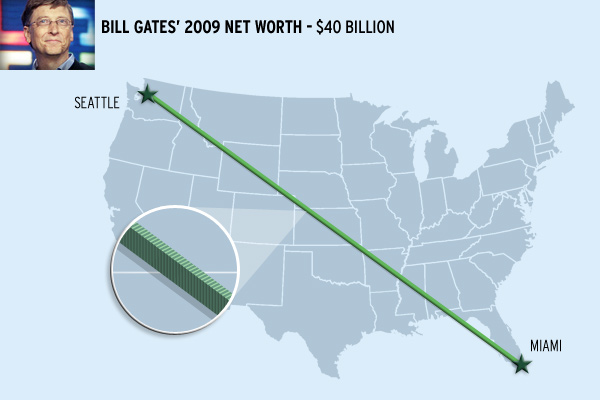
approximately the distance between Miami and Seattle.Bill Gates’ Net Worth - $40 Billion
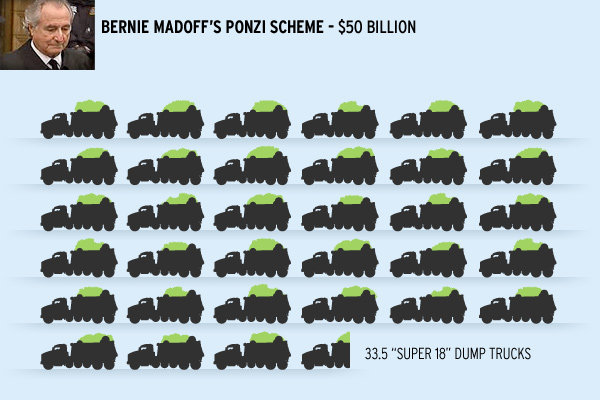
 In the largest Ponzi scheme in history, Bernard Madoff defrauded
thousands of investors for approximately $50 billion. That physical
amount of money would be difficult to transport, even in large
denominations. If you had $50 billion in $100 bills, the sheer volume
of the currency would be just under 20,000 cubic feet, enough to fill
33.5 “Super 18” dump trucks to capacity.
In the largest Ponzi scheme in history, Bernard Madoff defrauded
thousands of investors for approximately $50 billion. That physical
amount of money would be difficult to transport, even in large
denominations. If you had $50 billion in $100 bills, the sheer volume
of the currency would be just under 20,000 cubic feet, enough to fill
33.5 “Super 18” dump trucks to capacity. The Super-18 models are among the largest street-legal dump trucks currently available on the market, with 18 wheels and a hauling capacity of 22 cubic yards each.
Madoff’s Ponzi Scheme - $50 Billion
 With the potential failure of AIG posing considerable systemic risk,
the government has poured a total of approximately $173 billion into
the company to avoid disaster.
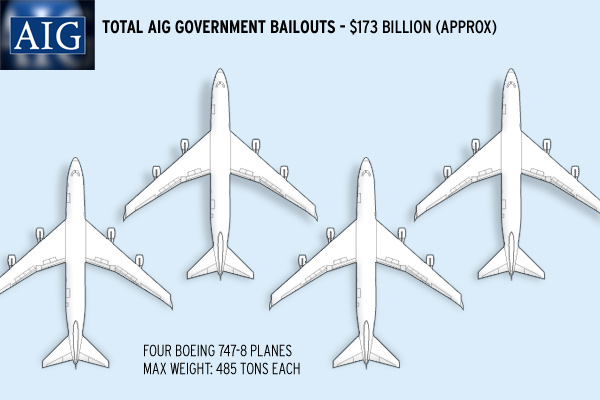
With the potential failure of AIG posing considerable systemic risk,
the government has poured a total of approximately $173 billion into
the company to avoid disaster. This amount would be massive (literally) if handed out in cash, weighing approximately 1,907 tons when denominated in $100 bills. That amount would weigh just short of four Boeing 747-8 jumbo jets at their maximum takeoff weight of 975,000 lbs, or 485 tons.
AIG Gov't Bailouts – $173 Billion
 With the largest market cap among U.S. companies, Exxon Mobil’s value
of publicly traded shares is over $345 billion (as of 3/31/09). If this
amount was denominated in $100 bills, the block of Benjamins covering
the area of a standard American football field would stack to a height
of about 28.7 feet.
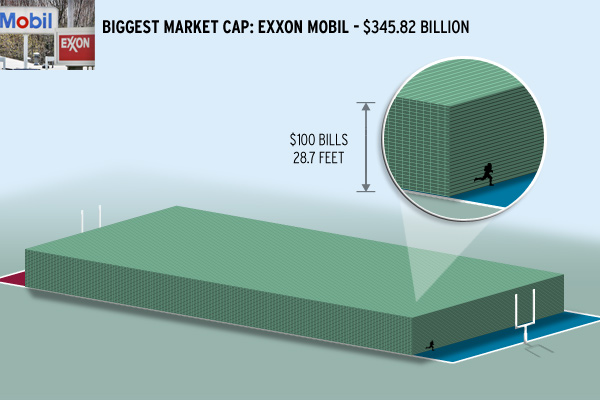
With the largest market cap among U.S. companies, Exxon Mobil’s value
of publicly traded shares is over $345 billion (as of 3/31/09). If this
amount was denominated in $100 bills, the block of Benjamins covering
the area of a standard American football field would stack to a height
of about 28.7 feet. XOM Market Cap - $345.82 Billion
 The Troubled Asset Relief Program (TARP) was implemented in order to
stabilize the country’s financial system, but has been heavily
criticized for the unprecedented volume of money involved: $700
billion.
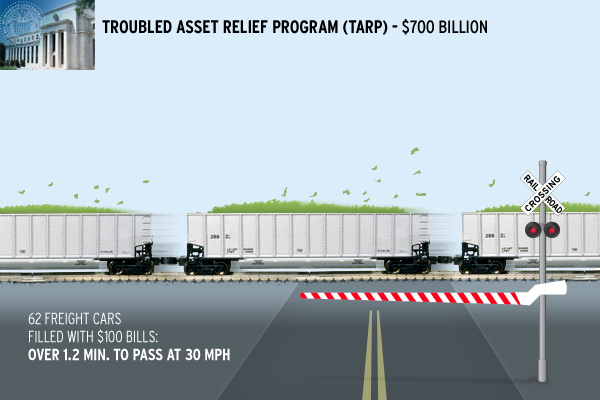
The Troubled Asset Relief Program (TARP) was implemented in order to
stabilize the country’s financial system, but has been heavily
criticized for the unprecedented volume of money involved: $700
billion. If this amount of money was denominated in $100 bills, the sheer volume of cash would be enough to fill to capacity 62 BethGon II high capacity railroad freight cars, according to information from FreightCarAmerica.
For a train moving at 30
mph, and at 48 feet per car, it would take about 1 minute, 12 seconds
for this money train to pass you by. If the TARP amount was denominated
in $1 bills, the train would be 6,175 cars long, stretching over 56
miles. At 30 miles per hour, it would take this train approximately 1
hour 52 minutes to pass you by.
TARP - $700 Billion
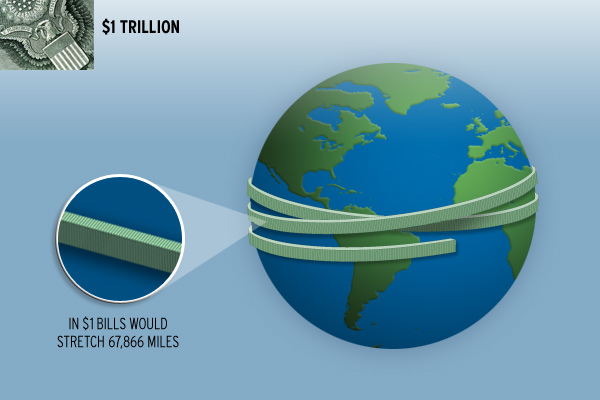
With several big spending plans brought up in the past few months, including Federal Reserve program to buy Treasury Securities as well as the Public-Private Investment Program, the total cost of these individual plans has been estimated to be as much as $1 trillion. This stack of cash - in $1 bills - would measure 67,866 miles, stretching approximately 2.72 times around the Earth’s equator.
If denominated in $100 bills, $1 trillion would be enough to fill 4.5 Olympic-sized swimming pools, with a total volume of 398,000 cubic feet. For comparison, there is only about $625 billion worth of $100 bills currently in circulation, according to the US Treasury bulletin, which would fill about 2.8 Olympic swimming pools.
 $11,046,247,657,049.48 (According to US Treasury Direct, 3/26/09)
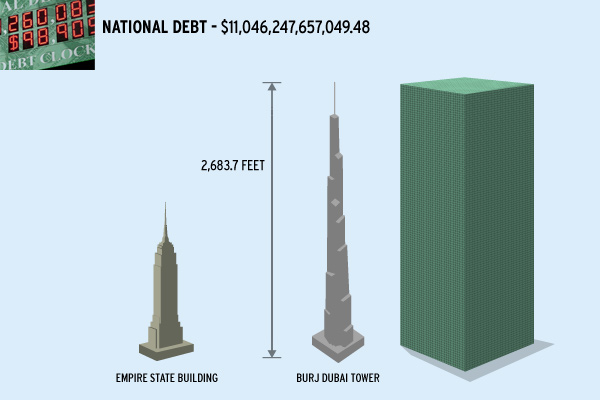
The mounting US National debt, growing by billions every day, has recently topped the $11 trillion mark. If denominated in $1 bills, the cash would stack as high as the tallest building in the world, the 2683.7 foot Burj Dubai skyscraper… 1,474,918 times. At this height, it would create a block of bills with a base approximately twice the size of the Empire State Building's, which is just under the size of three American football fields.
If consolidated into a single stack of $1 bills, it would measure about 749,666 miles, which is enough to reach from the earth to the moon twice (at perigee), with a few billion dollars left to spare. If the amount was laid out, the area of the $1 bills would cover the state of Rhode Island three times over, and in $100 bills the amount would carpet about 3/4 the area of Washington DC.
It is also interesting to note that this number is approximately 13 times the amount of US currency in circulation, according to the Treasury bulletin, which lists the amount at $853.6 billion as of December 31, 2008.
With several big spending plans brought up in the past few months, including Federal Reserve program to buy Treasury Securities as well as the Public-Private Investment Program, the total cost of these individual plans has been estimated to be as much as $1 trillion. This stack of cash - in $1 bills - would measure 67,866 miles, stretching approximately 2.72 times around the Earth’s equator.
If denominated in $100 bills, $1 trillion would be enough to fill 4.5 Olympic-sized swimming pools, with a total volume of 398,000 cubic feet. For comparison, there is only about $625 billion worth of $100 bills currently in circulation, according to the US Treasury bulletin, which would fill about 2.8 Olympic swimming pools.
$1 Trillion
At its maximum flow, water rushes over Niagara Falls at approximately
100,000 cubic feet per second, according to the Niagara Parks
association.
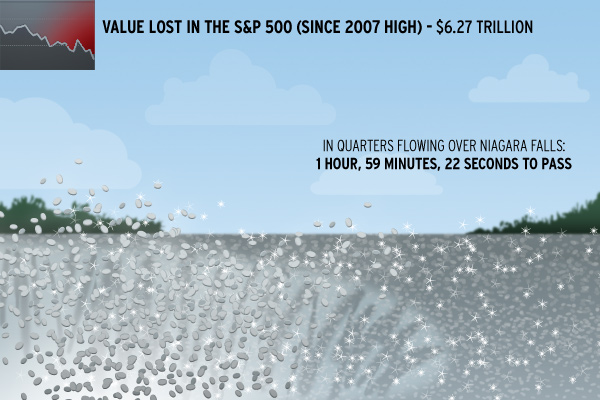
At this rate, if the value lost in the S&P 500 (between the October 2007 high and the market’s open on March 31, 2009) was denominated in quarters, the volume of coins would take approximately 1 hour 59 minutes 22 seconds to pour over the edge of Niagara Falls.
One can only imagine the sound it would make.
At this rate, if the value lost in the S&P 500 (between the October 2007 high and the market’s open on March 31, 2009) was denominated in quarters, the volume of coins would take approximately 1 hour 59 minutes 22 seconds to pour over the edge of Niagara Falls.
One can only imagine the sound it would make.
Value lost in S&P 500 - $6.27 Trillion
$11,046,247,657,049.48 (According to US Treasury Direct, 3/26/09)The mounting US National debt, growing by billions every day, has recently topped the $11 trillion mark. If denominated in $1 bills, the cash would stack as high as the tallest building in the world, the 2683.7 foot Burj Dubai skyscraper… 1,474,918 times. At this height, it would create a block of bills with a base approximately twice the size of the Empire State Building's, which is just under the size of three American football fields.
If consolidated into a single stack of $1 bills, it would measure about 749,666 miles, which is enough to reach from the earth to the moon twice (at perigee), with a few billion dollars left to spare. If the amount was laid out, the area of the $1 bills would cover the state of Rhode Island three times over, and in $100 bills the amount would carpet about 3/4 the area of Washington DC.
It is also interesting to note that this number is approximately 13 times the amount of US currency in circulation, according to the Treasury bulletin, which lists the amount at $853.6 billion as of December 31, 2008.
US National Debt
Watch Streaming Broadcast Live:

LRN.fm

DLive
Live Chat

Telegram
Telegram


