


IPFS
The Early Warning Signal to Follow in 2011
Written by Sierra Hancock Subject: Economy - Economics USA
The Early Warning Signal to Follow in 2011
Editor's note: For more insight and actionable investment advice on protecting your wealth in a difficult market from Jeff Clark, consider a trial subscription to DailyWealth.
Our mission at DailyWealth is to show you how to avoid risky investments, and how to avoid what the average investor is doing. We believe that you can make a lot of money – and do it safely – by simply doing the opposite of what is most popular. Click here for details on a free trial subscription.
Steve's note: My friend Jeff Clark is the best
short-term trader I know... I say that all the time. But what I don't
mention very often is, he's a fantastic market analyst over any time
frame.
Today, Jeff shows you the ultimate early warning signal to watch out for in 2011. Stocks are soaring, and people aren't looking for warning signs now. But Jeff shows one that's easy for you to follow.
Jeff will probably be right about this one, as he typically is. So my advice to you in 2011 is to ride your stocks as high as possible... And DILIGENTLY FOLLOW your trailing stops to avoid the downside risk Jeff warns about today...
Today, Jeff shows you the ultimate early warning signal to watch out for in 2011. Stocks are soaring, and people aren't looking for warning signs now. But Jeff shows one that's easy for you to follow.
Jeff will probably be right about this one, as he typically is. So my advice to you in 2011 is to ride your stocks as high as possible... And DILIGENTLY FOLLOW your trailing stops to avoid the downside risk Jeff warns about today...
The coming year could be a horrible one for stocks.
No, you won't hear that sort of talk from most of the folks on the
business networks. You won't hear it from your stockbroker. And you
won't hear it from your friends at any of the cocktail parties between
now and New Year's Day.
'Tis the season to be bullish.
No one wants to be bearish during the holidays. This is a time for
hope, a time for optimism, and a time to think of all the profits we'll
acquire in the next year.
However, if history is any sort of a guide, those profits are going
to go to investors betting on a fall in stocks. Let me explain...
Last month, I wrote that rising interest rates were flashing a warning signal.
Despite the Federal Reserve's intervention in the marketplace, yields
on long-term bond prices were rising, and bond prices were falling.
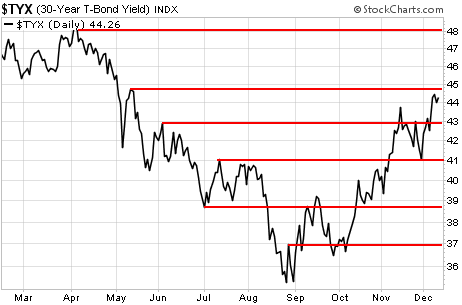
As you can see from the following chart, that trend has continued...
On Wednesday, the yield on the 30-year Treasury bond closed at
4.443% (44.43 on the chart) – the highest level in seven months.
Long-term bond prices are down more than 13% since mom and pop investors plowed their life savings into them at record-low rates in September.
The stock market hasn't even noticed... yet.
Stocks did hiccup a little bit last month. The S&P 500 dropped
about 5% during the last three weeks of November. But the index
recovered all of that loss and then some in just the first eight days of
December. That's hardly the "crisis" type action I warned about last
month.
Give it time.
For the past 30 years, bonds have been in a long-term bull market.
Interest rates fell and bond prices rose. There were two notable
exceptions to that trend – two short periods of time when interest rates
rose and bond prices fell. The first was from April to August of 1987.
The second was from April to December of 1999.
On April 1, 1987, the yield on the 30-year Treasury bond was 7.6%.
By mid-August of that year, it had risen to 9.2%. That was an increase
of 160 basis points, or roughly 21%. But the stock market didn't notice.
In fact, the S&P 500 gained 14% during that brief 3½-month period
when interest rates rose.
Of course, we all know what happened two months later. Stocks crashed. The S&P lost 30% of its value in October 1987.
To prevent a widespread panic, the Fed opened up the spigots. It
lowered interest rates and made easy money available to banks and
financial institutions to help stabilize the markets.
In April 1999, 30-year Treasury yields were 5.4%. They rose to
6.55% by December of that year. That's an increase of 115 basis points,
or roughly 21%. Again, the stock market didn't notice. Investors were
caught up in the "Internet mania" phase and the S&P rallied 18%
while interest rates were rising. It tacked on another 5% by March 2000.
Every dime of those gains was lost in the coming months. By the
time the market bottomed in early 2002, the S&P was down more than
40% from its high.
To prevent a widespread panic, the Fed opened up the spigots. It
lowered interest rates and made easy money available to banks and
financial institutions to help stabilize the markets.
Now look at what's happening today...
Long-term interest rates have risen from 3.55% on September 1 to
about 4.45% today. That's a gain of 90 basis points, or roughly 25%.
The stock market doesn't care. The S&P 500 index is up 17%.
There may be a little more room on the upside. After all, nobody wants a
crashing market for Christmas. But stocks are reaching the same point
in time and price as they experienced just before the market peaked in
1987 and 2000, 14%-20% rallies... and four to seven months between when
interest rates bottomed and stock prices peaked.
The end is near.
Since interest rates fell to such a low level, we'll probably need a
larger percentage increase to cause a disruption in the stock market.
My guess is a 4.9% yield on the 30-year Treasury bond will do the trick.
That would be a new yearly high for interest rates. In fact, it would
be a three-year high. Anyone who bought a long-term government bond
within the last three years would be underwater on the trade.
That's enough to kick off a bit of a panic.
And how will the Fed respond to it this time? The spigot is already
open as far as it can go. Short-term interest rates are at zero
percent. They can't go any lower. The Fed is already printing money to
buy Treasury bonds. How many more quantitative easing scams can they get
away with?
Here's my point...
During the 30-year bull market in bonds, we experienced two brief
periods where long-term interest rates increased significantly. Stocks
sold off dramatically following each of those periods. The Fed, however,
was able to "save" us each time.
Now bond prices are falling and interest rates are increasing
despite the Fed's unprecedented involvement in the marketplace. We are
in the early stages of a long-term bear market for bonds and a long-term
period of rising interest rates. This is something we haven't seen for
30 years. Indeed, many of us have never experienced it in all our adult
lives.
The trigger is 4.9%. Once 30-year rates get above that level, the game is over.
Take another look at the yield chart... 4.9% isn't that far off.
Best regards and good trading,
Jeff Clark
Editor's note: For more insight and actionable investment advice on protecting your wealth in a difficult market from Jeff Clark, consider a trial subscription to DailyWealth.
Our mission at DailyWealth is to show you how to avoid risky investments, and how to avoid what the average investor is doing. We believe that you can make a lot of money – and do it safely – by simply doing the opposite of what is most popular. Click here for details on a free trial subscription.
Further Reading:
Bonds may be going downhill fast, but Doc Eifrig has found an
alternative. "All you have to do," he says, "is buy what offers the
safety of bonds... and the upside of stocks." Find his favorite ideas
here: Don't Buy Bonds Now... Buy These Instead.
"Once rates break above resistance at 4.1%, it's a
straight shot higher," Jeff wrote last month. "Get out now while you
still have the chance." Rates just hit 4.45%. Time is running out. Get
the full story here: This Is Your Final Warning.
Watch Streaming Broadcast Live:

LRN.fm

DLive
Live Chat

Telegram
Telegram


