


IPFS
Weekend Edition
Written by Sierra Hancock Subject: Future PredictionsBy now, you should have seen Porter Stansberry's prediction for "The End of America."
His recent video was the culmination of years of research and
observation, which led him to this conclusion... The U.S. dollar and
economy are doomed. The U.S. government has printed more money and taken
on more debt than it can ever repay.
But the U.S.'s situation isn't unique. We've seen it play out many
times throughout history. Whenever a sovereign nation becomes so
indebted it can never hope to repay, it inflates. And the scary thing
is, inflation is already running rampant. Take a peek at the chart below
and its explanation from the most recent issue of his Stansberry's Investment Advisory newsletter...
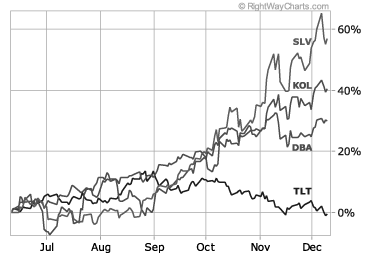
What you see here is the credit of the United States, represented by the value of a 20-year Treasury bond (TLT) versus the major alternatives to money: energy as represented by coal (KOL), agriculture (DBA), and hard money as represented by silver (SLV).This picture sums up the arguments and warnings we've been giving for years. We are not going to have a crisis. We are in a crisis right now. U.S. credit is now in permanent decline, while the value of the main alternatives to the dollar – energy, food, and real money – are soaring.The market is giving you a warning. Inflation is here. We are in the midst of a monetary crisis. The facts are undeniable. – Stansberry's Investment Advisory, December 2010
 As Chris Weber points out in this week's DailyWealth,
gold has risen for 10 consecutive years. Going all the way back to
1980, Chris never found another market with the same consistency.
As Chris Weber points out in this week's DailyWealth,
gold has risen for 10 consecutive years. Going all the way back to
1980, Chris never found another market with the same consistency.And he agrees gold's rally isn't over. Go to the grocery store and
ask people if they own gold... Not gold jewelry, but actual gold
bullion. Most do not. Sure, gold is making headlines. But until your
waiter, auto mechanic, and tailor are showing off their new Canadian
Maple Leafs, you can bet gold will rally. If we do see a short-term dip
down to $1,300 or $1,200, we'd treat it as a tremendous buying
opportunity.
And it helps that the Federal Reserve is hell-bent on printing the
dollar into oblivion. This week, the Fed released minutes from its
December 14 meeting... Attendees dismissed rising long-term Treasury
rates as a strengthening economy (no inflation here). Officials also
committed to the $600 billion Treasury bond purchase program proposed in
November. According to the Fed's minutes:
While the economic outlook was seen as improving, members generally felt that the change in the outlook was not sufficient to warrant any adjustments to the asset-purchase program. Some indicated that they had a fairly high threshold for making changes to the program. (Emphasis is our own.)
We're not sure what it will take to hit the Fed officials' "high
threshold"... Perhaps when interest rates hit double digits, and we're
walking to the store with wheelbarrows of cash. But we're sure the
dollar will be far less valuable by the time the Fed quenches its thirst
for printing.
In addition to rising interest rates, another "End of America"
prediction is also playing out... Soaring food prices. Last November,
Porter attended a secret meeting with some of the world's most powerful
people (billionaire investors, government officials, and corporate CEOs)
to discuss the looming food crisis. While most attendees tiptoed around
the central issue, Porter dove in. He recalled his contribution to the
meeting in the November 2010 issue of Stansberry's Investment Advisory...Excuse me... I wonder if everyone here is merely trying to be polite... We are here talking about the risks to the global food supply chain because we all know food prices are rising rapidly and these price shocks are merely the beginning.We all know there's a currency war underway – a currency war that began in 2008 with the collapse of Wall Street's investment banks. We all know this will, eventually, lead to a trade war. And we all know that as sure as night follows day, a currency war will lead to a trade war. We know this will have catastrophic consequences for food supplies.But why hasn't anyone yet pointed to the obvious problem?It terms of gold, agricultural commodities prices have fallen by about 50% over the last 10 years.Obviously it's not the price of food that's the problem. It's the collapsing purchasing power of the U.S. dollar that's led us to this situation.That's what's going to cause a food crisis – and an energy crisis.The real question we should be discussing isn't food. It's money. And more specifically, the lack of a sound world reserve currency.
As Porter predicted, the weakening currency caused food prices to
rise. According to the United Nations, world food prices hit an all-time
record last December (besting the 2008 levels that sparked deadly riots
across the world). An index of 55 food commodities followed by the Food
and Agriculture Organization rose for the sixth month to 214.7, above
the June 2008 high of 213.5. To see how Porter recommends protecting
yourself from the global food shortage – and every other "End of
America" scenario – click here...
Regards,
Watch Streaming Broadcast Live:

LRN.fm

DLive
Live Chat

Telegram
Telegram


