


News Link • Agriculture
The Fertilizer Crisis That Will Hit Your Grocery Bill
• https://www.crisisinvesting.com, Lau VegysSix weeks. That's how long the Strait of Hormuz has been effectively closed. You know the oil story by now — Brent near $100, daily headlines about ceasefires that collapse within hours. But there's a different side to this crisis — one that's going to hit you at the grocery store, not the gas pump.
You see, the Strait of Hormuz isn't just an oil chokepoint. It also handles major volumes of LNG and petrochemicals — and almost half of all seaborne fertilizer trade.
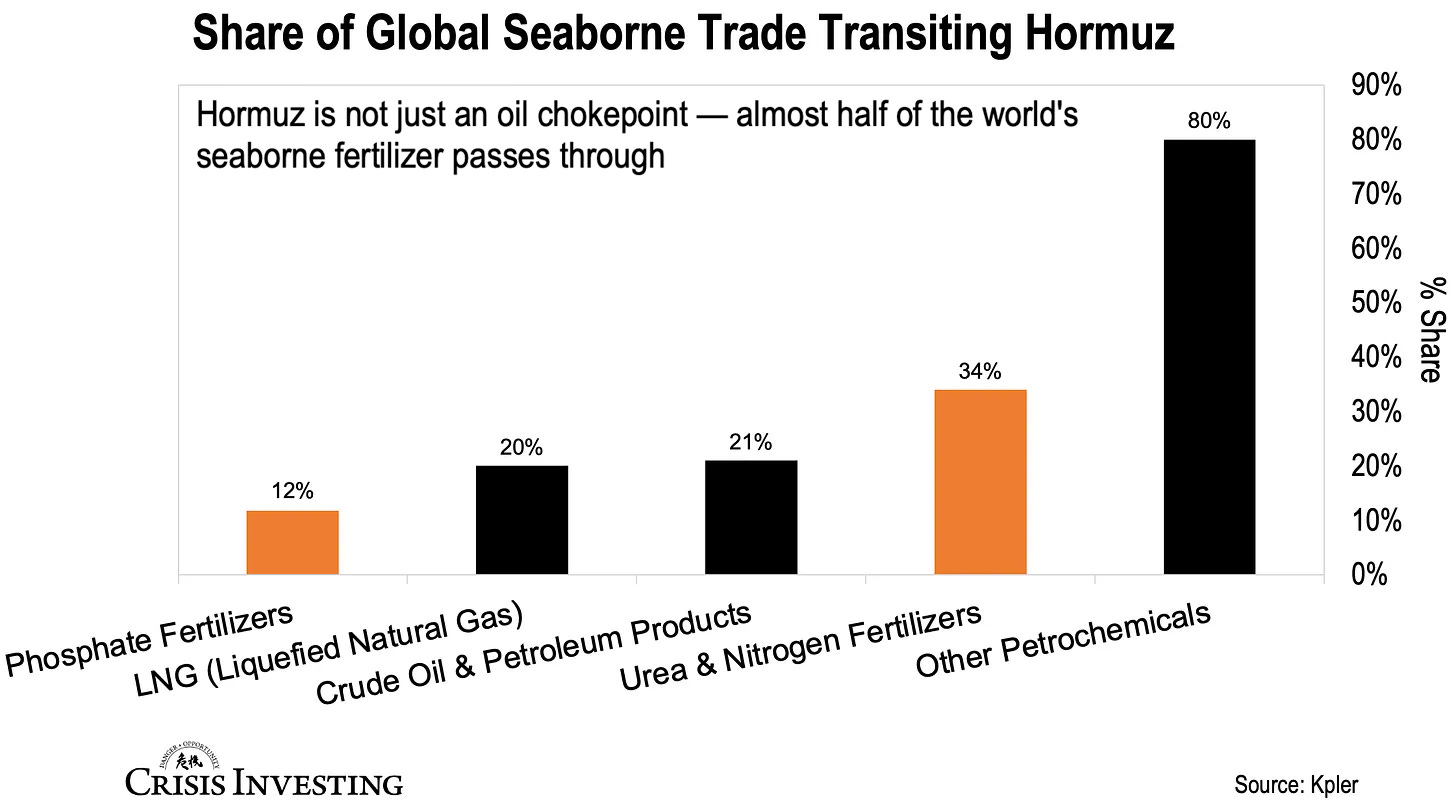
Break it down, and the Persian Gulf accounts for 30–35% of global urea exports, 20–30% of ammonia, around 12% of phosphate fertilizers, and roughly a quarter of globally traded sulfur. That's, again, roughly half of the world's seaborne fertilizer supply running through a single chokepoint.
And unlike oil, there are no bypass pipelines for bulk ammonia. No strategic fertilizer reserve to tap. No shadow fleet of tankers quietly moving cargo with transponders off. When fertilizer gets stuck, it just stays stuck.
The prices are telling you exactly that. Urea at the Port of New Orleans — the benchmark for U.S. fertilizer — has blown past $650 per ton, up nearly 40% since the conflict began. Futures are above $690. Some spot markets are reportedly clearing well above $700. These aren't numbers anyone budgeted for.
Here's why that matters to you. Right now — this week, this month — is the spring planting window across the Northern Hemisphere. Farmers are deciding how many acres of what crop, how much fertilizer to apply, whether the math still works at $690 urea. Those decisions determine how much food the world produces for the rest of 2026. And they don't get a do-over.
You can already see it in the data. Corn — the most nitrogen-intensive major grain, at roughly $166 per acre in nitrogen costs — is where the squeeze manifests most clearly. The U.S. Department of Agriculture's February study flagged a potential shift away from corn toward soybeans. Their March 31 report confirmed it: corn acreage expected to fall 3.5%, soybeans up 4.3%. In short, farmers are doing the math and switching.
Watch Streaming Broadcast Live:

LRN.fm

DLive

Telegram


