


IPFS

Menckens Ghost
More About: Police StateThe Wall Street Journal: A Sewage Blunder Earns Engineer a Criminal Record
Many Americans believe that although the nation has morphed into a Mussolini-style corporatist state, the rule of law--laws passed by an elected legislature--keep citizens from being prosecuted without cause in violation of basic civil liberties. The following article will disabuse them of the second notion. We now have rule by unelected agencies. Question: If we revolt against rule by unelected agencies, are we breaking the law? Just asking. Just a hypothetical question.
Mencken's Ghost
BOWIE, Md.—Lawrence Lewis was raised in the projects of Washington, D.C. By the time he was 20, all three of his older brothers had been murdered and his father was dead of a heart attack.
Seeking an escape, he took night classes while working as a janitor for the D.C. school system. He rose to become chief engineer at a military retirement home. He raised his two youngest daughters alone, determined to show them how to lead a crime-free life.
That goal was derailed by blocked toilets.
In 2007, Mr. Lewis and his staff diverted a backed-up sewage system into an outside storm drain—one they long believed was connected to the city's sewage-treatment system—to prevent flooding in an area where the sickest residents lived. In fact, the storm drain emptied into a creek that ultimately reaches the Potomac River.
Eight months later, Mr. Lewis pleaded guilty in federal court to violating the Clean Water Act. He was given one year's probation and placed under court-ordered supervision.
"I got a criminal record from my job—when I thought I was doing the right thing?" says Mr. Lewis, 60 years old.
Mr. Lewis was caught in Washington's four-decade expansion of federal criminal law. Today, there are an estimated 4,500 federal crimes on the books, a significant increase from the three in the Constitution (treason, piracy and counterfeiting). There is an additional, and much larger, number of regulations written to enforce the laws. One of those regulations ensnared Mr. Lewis.
Many of these federal infractions are now easier to prosecute than in the past because of a weakening in a bedrock doctrine of Anglo-American jurisprudence: the principle of mens rea, or "guilty mind," which holds that a person shouldn't be convicted if he hasn't shown an intent to do something wrong. A law without a mens rea requirement tripped up Mr. Lewis.
Nobody, including Mr. Lewis, argues that dumping waste into a creek is a good idea. However, critics of the federal criminal justice system argue the government is criminalizing mistakes that might more appropriately be handled with civil fines or injunctions. In Mr. Lewis's case, a Justice Department court filing acknowledged he didn't realize the waste was going into the creek.
In fact, the building's manager and Mr. Lewis's then-supervisor, retired Navy Capt. Craig Sackett, says it was long standard practice at the home—predating Mr. Lewis's tenure—to divert overflow into nearby storm drains if a backup occurred. This prevented floods within the building itself. Like Mr. Lewis, Mr. Sackett says he thought the flow was going into the district's waste-treatment system.
He says he doesn't know why Mr. Lewis was the one prosecuted. "It was either him or me," Mr. Sackett says, "and they certainly talked to me."
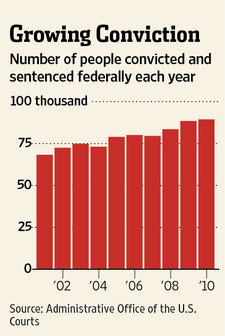
Mr. Lewis was one of 788,517 people sentenced for federal crimes between 2000 and 2010. Most were hit with felonies, such as fraud or drug dealing, which can carry prison sentences reaching into the decades.
Tens of thousands were found guilty of misdemeanors, which typically carry jail terms of up to a year. Though less serious than felonies, the possible impact of a misdemeanor conviction on getting a job or a loan or other aspects of everyday life "can be quite grave," says Prof. Robert Boruchowitz of Seattle University law school, who has studied the issue.
"You have a large community of people who are not considered criminals in the traditional sense," living with the consequences "for the rest of their lives," says Lisa Wayne, president of the National Association of Criminal Defense Lawyers.
Applications for jobs, loans and occupational licenses—ranging from auctioneers to plumbers—ask about a person's criminal history. While a conviction is rarely an automatic disqualification, it can often tip the balance against an applicant, observers say.
As a teen, Mr. Lewis says, he was arrested for assault after getting into a fight, but was found not guilty. Bad tempers are a family inheritance, he says.
In 1969 his brother Warren was shot to death. His brother Nathan Jr. was gunned down in 1971. His father, Nathan Sr., had a fatal heart attack when told of his namesake's death. His third brother, Roy, was stabbed to death weeks later while in prison on an assault charge.
At first, Mr. Lewis was fatalistic. "We had the same life. We came out of the same womb. Why was I different? When was my time coming?" he recalls thinking.
To escape from the world that took his family, he started work as a janitor for the D.C. Education Department earning $1.80 an hour. He began taking facilities-management classes at night and learning about power plants, boiler rooms and maintenance. By the time he left the Board of Education in 1993, after 24 years, he had risen to Facility Manager, making nearly $50,000 a year.
Eventually he moved on to the Knollwood military retirement center, a sprawling network of living facilities housing 300 veterans, their spouses and survivors on 16 acres in northwest Washington.
Sanford Morgan, Knollwood's engineer before Mr. Lewis, says sewage was a recurring problem. According to court documents, blockages were usually caused by elderly residents flushing adult diapers down the toilets. The backup would clog the pump that normally pushed waste to the appropriate disposal system.
Melissa Golden for The Wall Street Journal
Sewage went into Rock Creek, which feeds the Potomac.
"I made many attempts to correct it," says Mr. Morgan, who has known Mr. Lewis for more than 20 years and calls him "a straight-up guy."
At 7:30 a.m. on March 29, 2007, Mr. Lewis and his employees hooked up a hose to deal with the latest problem. They pumped sewage into the storm drain until 2:30 p.m., stopping only when authorities began arriving. A jogger in nearby Rock Creek Park had noticed the usually clear creek water was murky. The Park Police traced the source to Knollwood.
Mr. Sackett was at Arlington National Cemetery interring his father-in-law when he got the call. He recalled more emergency vehicles at Knollwood "than I'd seen in my entire life."
Rock Creek is a small tributary that flows from Maryland through Washington, D.C., and into the Potomac River. For most of its 12 miles, it isn't possible to put a boat into the water.
For decades, federal law only covered waters deemed navigable under the Rivers and Harbors Act of 1899. Over the years, it became waters that could be made navigable. In 1972 the Clean Water Act further broadened the law, as Congress became concerned about pollution and water quality, spurred by high-profile incidents such as the Cuyahoga River catching fire in 1969.
The Environmental Protection Agency and the U.S. Army Corps of Engineers, which had the job of writing regulations to enforce the 1972 law, expanded the "waters of the United States" definition to include tributaries such as Rock Creek. The argument was that pollution can move downstream to larger bodies of water, says David M. Uhlmann, director of the Environmental Law and Policy Program at the University of Michigan Law School.
Spurred by the 2007 raid, Knollwood solved its backup problem by cutting a new manhole and clearing a buildup of lime, grease and sludge. Mr. Lewis voluntarily attended EPA classes to learn more about procedures and regulations.
Mr. Lewis initially wanted to go to trial and fight the charges against him. He says he had served on many juries over the years and felt his peers would understand the difference between a criminal act, and a well-intentioned but mistaken act.
"I said, to hell with pleading guilty, I'm innocent," Mr. Lewis recalls.
But Mr. Lewis's lawyer, Barry Boss, told him his argument would be tough to make. (Knollwood paid for Mr. Boss to represent Mr. Lewis.)
In an interview, Mr. Boss said, "There was no fight to have. It was a strict liability case," meaning the government didn't have to prove Mr. Lewis knew he was doing anything wrong. "His good intentions did not matter." The lawyer told Mr. Lewis that, to be found guilty, prosecutors needed only to prove that he was aware that sewage was being pumped into the storm drain that led to the creek.
In court documents, the government argued that Mr. Lewis didn't ensure the storm drain fed into a waste-treatment facility rather than the creek. About 30% of the city's storm drains flow to a treatment plant, according to the D.C. Water and Sewer Authority. Plus, the government argued, Mr. Lewis was responsible for several prior discharges during his time at Knollwood.
Mr. Lewis decided to plead guilty, fearful he would lose his house if he fought the charge. He has legal custody of his two youngest children (he has four others). His mother, Nancy Lewis, 96, also lives with him.
He entered a guilty plea in December 2007. Prosecutors agreed probation and a $2,500 fine would be sufficient penalty.
The U.S. Attorney's Office declined to comment on Mr. Lewis's case or on whether it considered charging other individuals.
As the family drove to the courthouse for his sentencing, Mr. Lewis told his daughter Ijananya, then 16, she might have to drive home if he ended the day in prison.
A few weeks later, Mr. Boss, Mr. Lewis's attorney, took his client to the probation office for the first time and recalls him crestfallen. "He was telling me how he'd spent his adult life trying to show his daughters that not every African-American man is caught up in the criminal-justice system." Mr. Lewis says he regularly brings his children to the graveyard where his brothers are buried, or back to the projects, to show them the consequences of bad choices.
Bitter over his conviction, he left Knollwood. He filled out several job applications, all of which asked if he had ever been arrested or convicted. None of the potential employers ever called, he says.
Two months into his job search he filled out an application for a job at Gallaudet University in Washington. It asked if he had a felony record or a misdemeanor conviction that required imprisonment—a question that allowed him to answer "no." He got hired.
He didn't volunteer any information about his guilty plea to his new employers. But his probation officers put him in an awkward position, Mr. Lewis says, by making regular spot checks at the university.
In one instance, Mr. Lewis's supervisor at Gallaudet noticed the officers and asked Mr. Lewis what they wanted. "I told him it was somebody I knew who had just stopped by to check on me," Mr. Lewis says.
The next time the probation officers came by, "I tried to explain it could create problems for me," Mr. Lewis says. "They were nice about it, but they said, 'We have to keep coming.'"
The probation office referred questions to the Administrative Office of the U.S. Courts, which wouldn't comment on Mr. Lewis's case.
Meloyde Batten-Mickens, executive director of facilities at Gallaudet, says Mr. Lewis had mentioned he had been in trouble, but didn't provide specifics until more recently, when he told her the full story. Knowing about his prior conviction makes no difference, Ms. Batten-Mickens says. "I trust him across the board."
On probation, Mr. Lewis had to fill out monthly cash-flow statements showing his salary and spending to prove he wasn't involved in any unusual activities. He had to hand over his .357-caliber revolver to a family member for the duration of his probation.
He also temporarily lost privacy protections, as he learned when probation officers made an unannounced 6 a.m. search of his home. They would tell him only that he'd had an unauthorized contact with police, a potential probation violation. Mr. Lewis says he assumes the officers were referring to a traffic stop he had recently been involved in—a stop that didn't produce a traffic ticket.
After searching his home for a couple of hours the officers left and never took any further action. "They went through everything," Mr. Lewis says. "You'd have thought I had killed somebody."
Today, Mr. Lewis's life is moving back to normal. He has a second job at the power plant run by the University of the District of Columbia, where he was hired after coming off probation.
For his family, the episode has left a strong impression. Mr. Lewis's youngest daughter Shirley, 16, a high-school junior with a 3.8 grade-point average, says her father's conviction and the circumstances surrounding it have "given me a firsthand look at what the world is like."
Mr. Lewis says his lowest point came around the time of his conviction when he went to the courthouse to be fingerprinted and have his mug shot taken.
"I was treated like everybody else, like I was a hardened criminal" he says. "Imagine what I looked like. 'What you in for? Backed up toilets.'"
Copyright 2011 Dow Jones & Company, Inc. All RiWatch Streaming Broadcast Live:

LRN.fm

DLive

Telegram


