


09-18-12 -- Carla Gericke - Bill McDorman - Sky Conway (MP3 & Video LOADED) RERUN
Hour 1 - 3


Hour 2
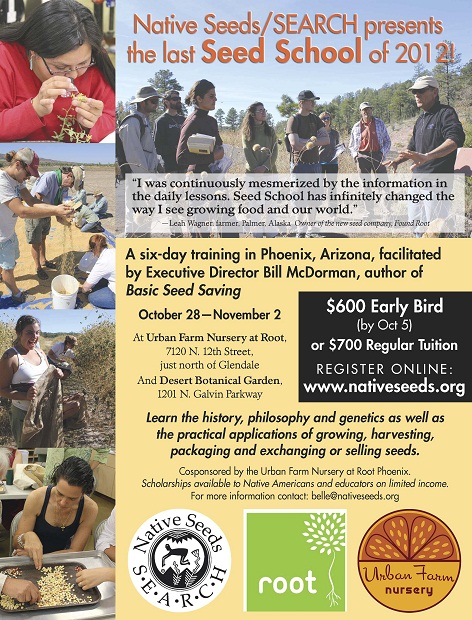
Bill McDorman is Executive Director of Native Seeds/SEARCH in Tucson, Arizona. Bill has been in the bio-regional seed business almost 30 years, founded 3 seed companies, Garden City Seeds, High Altitude Gardens and Seeds Trust, and co-founded several non-profits including the Sawtooth Botanical Garden in Ketchum, Idaho. He is author of Basic Seed Saving, 1994.
Bibliography
http://www.agtoseeds.com/ All Good Things Organic Seeds offers quality vegetable and herb seeds that are adapted to organic growing conditions and perform vigorously in diverse climates. Ojai, California.
http://www.aosaseed.com/ Website of the Association of Official Seed Analysts, Inc. which establishes rules for seed testing & influences seed legislation at the state and federal levels in the USA.
http://www.aravaipa.com/ Aravaipa Heirlooms, Open-pollinated, Heirloom, Wild, Organic Vegetable Plants, Endangered, Southwestern, Mexican, Desert tolerant.
http://www.bioversityinternational.org/ “Bioversity undertakes, encourages and supports research aimed at enhancing the sustainable use and conservation of agricultural biodiversity to the world's most vulnerable communities…”
http://www.crcworks.org/crcdocs/azsouthsum11.pdf Southern Arizona Local Farm & Food Economy, Highlights of a data compilation by Ken Meter, Crossroads Resource Center (Minneapolis) for Community Food Bank of Southern Arizona, December 30, 2011. Covers Cochise, Graham, Greenlee, Pima, & Santa Cruz Counties of Arizona.
http://www.crcworks.org/crcppts/azsouth12.pdf Ken Meter’s powerpoint presentation about the state of agriculture in Southern Arizona.
http://www.etcgroup.org ETC Group monitors the impact of emerging technologies and corporate strategies on biodiversity, agriculture and human rights. Source of seed ownership graphs.
http://www.foundroot.com/ Foundroot is a small family-owned Alaskan business offering 100% open-pollinated vegetable seeds. We specialize in rare, heirloom, and expertly-bred seeds that will thrive to the far reaches of the frozen north. Tough climate? Tough seeds.
http://www.fourseasonfarm.com/ “Four Season Farm is an experimental market garden in Harborside, Maine, owned and operated by writers Barbara Damrosch and Eliot Coleman. The farm produces vegetables year-round and has become a nationally recognized model of small-scale sustainable agriculture.” Find links to books by these authors at their website.
http://www.growingpower.org/ Growing Power, Will Allen’s award winning urban food project in Milwaukee, WI.
http://www.kew.org/index.htm Founded in the 16th & 17th centuries along the Thames in England, Kew Gardens has been a leader in plant & seed science and in conserving the Earth’s biodiversity. Their mission statement is simple: To inspire and deliver science-based plant conservation worldwide, enhancing the quality of life.
http://www.library.pima.gov/seed-library/ Pima County Seed Library web page.
http://www.livingseedcompany.com/livingseed/welcome.html The Living Seed Company, Nicasio, California. Heirloom and Open Pollinated Seed Collections.
http://www.mediafire.com/view/?zw6n2g4f2ou6rqz Hungry for Change, Borderlands Food and Water in the Balance, The Southwest Center’s Kellogg Program in Sustainable Food Systems by Gary Nabhan, Maribel Alvarez, Jeffrey Banister and Regina Fitzsimmons.
http://www.nativetech.org/ “An internet resource for indigenous ethno-technology focusing on the arts of Eastern Woodland Indian Peoples, providing historical & contemporary background with instructional how-to's & references.”
http://www.pesticide.org/ The Northwest Coalition for the Alternatives to Pesticides has scores of material safety data sheets on hundreds of pesticides with fact filled information researched by the non-profit organization not the companies who make the chemicals.
http://www.plants.usda.gov/java/ The USDA plants database provides standardized information about the vascular plants, mosses, liverworts, hornworts, and lichens of the U.S. and its territories.
http://www.responsibletechnology.org/ A website that “has become one of the most respected resources for online videos, podcasts, blogs, and reports for accurate and up to date information on GMOs.”
http://www.richmondgrowsseeds.org/ From Richmond, CA this site helps educate folks on starting a seed lending library and also provides seeds, education and information about saving seeds.
http://www.seedalliance.org/Home/ Website of the Organic Seed Alliance in Port Townsend, Washington. Find info about organic farming and gardening as well as seed-saving.
http://www.soilsecrets.com/ssindex.swf The website of Michael Martin & Kari Melendrez, leaders in growing regionally-adapted trees of the Chihuahuan Desert in the Southwest USA. While a student in 1974, Michael began developing a protocol for healthy soil that is now called Soil Secrets.
http://www.thelearninggarden.org/index.html The website for one of the first school-based gardens in the US.
https://www.msu.edu/~howardp/ Philip H. Howard, Associate Professor, Michigan State University, teaches undergraduate and graduate courses in Community, Food and Agriculture, as well as a graduate course in Research Methods. He is the source of the corporate ownership graphs.
Allard, Robert W. (1999). Principles of Plant Breeding, 2nd Edition
Coleman, Eliot (1995). The New Organic Grower, White River Junction, VT: Chelsea Green Publishing Co.
Coleman, Eliot (1999). Four Season Harvest, White River Junction, VT: Chelsea Green Publishing Co.
Cummings, Claire Hope (2008). Uncertain Peril: Genetic Engineering and the Future of Seeds. Boston: Beacon Press.
Deppe, Carol (2000). Breed Your Own Vegetable Varieties: The Gardener's & Farmer's Guide to Plant Breeding & Seed Saving. White River Junction, VT: Chelsea Green Publishing Co.
Deppe, Carol (2010). The Resilient Gardener: Food Production and Self-Reliance in Uncertain Times. White River Junction, VT: Chelsea Green Publishing Co.
Epel, Thomas J. (2004). Botany in a Day: The Patterns Method of Plant Identification. Pony, MT: Hops Press, LLC.
Federoff, Nina V., Nancy Marie Brown (2006). Mendel in the Kitchen: A Scientist’s View of Genetically Modifie Food. Washington, DC: Joseph Henry Press.
Flannery, Tim (2001) The Eternal Frontier: An Ecological History of North America and Its People. Atlantic Monthly Press
Fowler, Cary, Pat Moony (1990). Shattering: Food, Politics and the Loss of Genetic Diversity. Tucson, AZ: University of Arizona Press.
Hemenway, Toby (2009). Gaia’s Garden: A Guide to Home-scale Permaculture. White River Junction, VT: Chelsea Green Publishing Co.
Jeavons, John (2006). How to Grow More Vegetables and Fruits (and fruits, nuts, berries, grains, and other crops) Than You Ever Thought Possible on Less Land Than You Can Imagine. Berkeley, CA: Ten Speed Press.
Kesseler, Rob, Wolfgang Stuppy, Alexandra Papadakis, Sir Peter Crane (2006). Seeds: Time Capsules of Life. Firefly Books
Kimbrell, Andrew, Nell Newman (2007). Your Right to Know: Genetic Engineering and the Secret Changes in your Food. San Rafael, CA: Earth Aware Editions.
Nabhan, Gary (2011). Where Our Food Comes From: Retracing Nikolay Vavilov's Quest to End Famine. Washington, DC: Island Press.
Robinson, Kim Stanley (1997). Future Primitive: The New Ecotopias. NY: Tom Dougherty Associates, Inc.
Suzuki, David T., Anthony J.F. Griffiths, Richard Lewontin (1989) Introduction to Genetic Analysis, W.H. Freeman and Co, Ltd, 4th Ed.
United States Dept of Agriculture (1961). Seeds: The Yearbook of Agriculture 1961.
Walljasper, J. (2010). All That We Share: How to Save the Economy, the Environment, the Internet, Democracy, Our Communities, and Everything Else that Belongs to All of Us. NY, NY: The New Press
White, Rowen, Bryan Connolly (2011). Breeding Organic Vegetables A Step-by-Step Guide For Growers, Ed. Elizabeth Dick, Northeast Organic Farming Association of New York (NOFA-NY)
Hour 3